

 by
by 
Every week, buyers across Karachi commit booking advances — sometimes PKR 5 lakh, sometimes PKR 50 lakh — on the strength of a photocopied building plan bearing an SBCA stamp. They assume that stamp means the land is legally owned, the floors are approved, and the project is safe to invest in. In most cases, at least one of those three assumptions is wrong.
Quick Navigation (Tap to view 12 sections) ▾
SBCA property title verification Karachi is not a single-step website check. It is a structured, dual-track due-diligence process that separates land ownership legality from structural building legality — two entirely different legal questions governed by entirely different authorities. Conflating them is the single most expensive mistake a Karachi property buyer can make in 2026.
This guide gives you the complete framework: the three SBCA instruments you must distinguish, the jurisdictional map that determines which authority governs your target property, the exact physical procedure at the SBCA Civic Centre One-Window Cell, the 20–30 year title chain documents you must collect before any token payment, and the five hard stop-payment triggers that should immediately pause any deal regardless of seller pressure.
Key Takeaways (Executive Summary)
Primary Insight: An SBCA-approved building plan and a valid NOC for Sale are two separate instruments — and neither one confirms that the underlying land title is legally clear or free from disputes.
Financial Impact: Buyers who purchase units in buildings with non-compoundable violations (unauthorized floors, COS encroachments, amenity plot construction) face potential demolition exposure, permanent utility disconnection, and inability to execute registered sub-leases — with zero legal recourse against the developer if the NOC for Sale was absent at the time of booking.
Legal / Due Diligence Check: Verify three tracks independently: (1) land ownership title at KDA/BOR/DHA/Cantonment, (2) SBCA building approval status and NOC for Sale at sbca.gos.pk and Civic Centre, and (3) physical on-site cross-audit of sanctioned floors vs. actual construction.
Actionable Recommendation: Do not pay any token, bayana, or booking advance until you hold a certified true copy of the SBCA status report, a verified Non-Encumbrance Certificate from the Sub-Registrar, and a complete unbroken title chain from the original allotment to the current seller.
1. Why SBCA Verification Is Non-Negotiable in 2026 Karachi Real Estate
The Scale of Unapproved Construction Across Karachi’s Central Districts
Karachi’s construction sector operates at a scale that its regulatory infrastructure has historically struggled to match. Across central districts — Gulshan-e-Iqbal, Clifton, Nazimabad, North Nazimabad, Saddar, and PECHS — a significant proportion of multi-story residential and commercial buildings carry some form of deviation from their sanctioned building plans. These deviations range from minor interior partition shifts (compoundable) to entire unauthorized floors constructed above the approved height limit (non-compoundable and subject to mandatory demolition under Section 19 of the Sindh Building Control Ordinance 1979).
The Sindh Building Control Authority (SBCA) maintains a public register of blacklisted developers and projects under active sealing or show-cause orders — but this register is only useful to buyers who know it exists and know how to read it. The majority of buyers in Karachi’s secondary and off-plan markets never consult it.
What a Single Missing Document Can Cost You — Financial and Legal Exposure
The financial consequences of skipping SBCA property title verification Karachi are not theoretical. Consider a buyer who purchases a top-floor apartment in a building where the developer constructed two unauthorized floors above the sanctioned limit. That buyer cannot:
- Obtain a registered sub-lease from the Sub-Registrar (because the Completion Certificate is absent or invalid for those floors).
- Get a permanent K-Electric or SSGC connection in their own name (Section 18-G bars utilities from connecting buildings without a valid Completion Certificate).
- Sell the unit to a bank-financed buyer (banks require clean title and utility connections for mortgage approval).
- Resist a Sindh High Court demolition order if the SHC issues a Section 7-A enforcement notice against the building.
The Sindh High Court has consistently enforced demolition orders against non-compoundable violations across Karachi’s central districts, and the Federal Constitutional Court’s landmark July 2026 ruling — while strengthening due-process protections for bona-fide purchasers — did not eliminate demolition as a remedy for non-compoundable structural violations. It only mandated that administrative show-cause procedures under Section 7-A be followed before execution.
2. The Fatal Misconception: Land Title and Structural NOC Are Two Completely Separate Things
This is the most important section of this guide. Before conducting any SBCA property title verification Karachi, you must understand that you are actually conducting three separate verification exercises — not one.
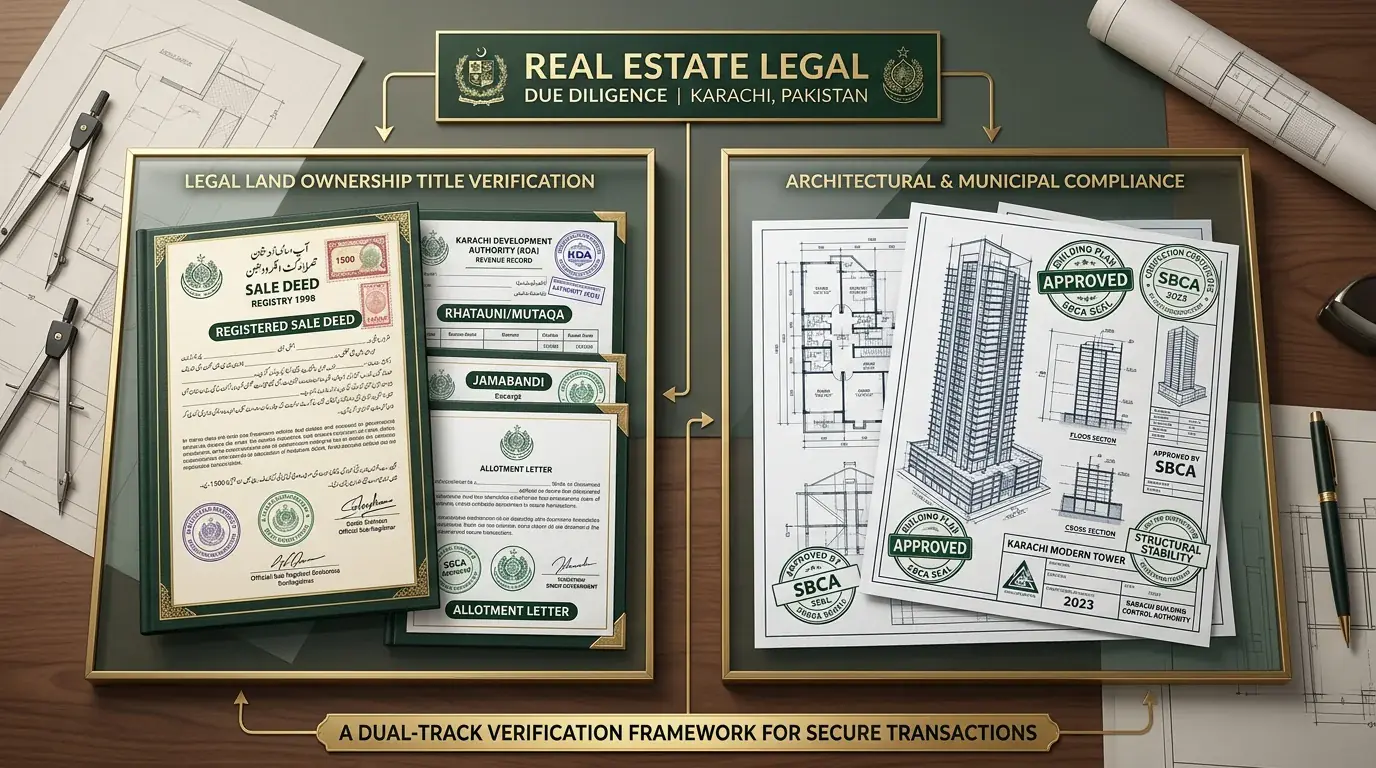
Track 1 — Ownership and Land Title Due Diligence: KDA, BOR, DHA, and Cantonment Boards
Track 1 answers the question: Who legally owns this land, and is that ownership free from mortgages, court attachments, or fraudulent double allotments?
This track has nothing to do with SBCA. It is governed by the primary lessor authority for the land in question — which could be the Karachi Development Authority (KDA), the Malir Development Authority (MDA), the Lyari Development Authority (LDA), the Defence Housing Authority (DHA), a Cantonment Board, a Cooperative Housing Society, or the Sindh Board of Revenue (BOR) for rural/deh land. The key documents are the original Allotment Order, Possession Order, Registered Lease Deed (Form B / 99-year lease), chain of Mutation Orders (Intiqal), and a Non-Encumbrance Certificate (NEC) from the Sub-Registrar.
Track 2 — Structural and Building Legality Due Diligence: SBCA’s Jurisdiction and Limits
Track 2 answers the question: What has been legally approved to be built on this land, and has the developer complied with those approvals?
This track is governed exclusively by SBCA under the Sindh Building Control Ordinance (SBCO) 1979 and the Karachi Building & Town Planning Regulations (KB&TPR) 2002. SBCA’s jurisdiction covers building design approval, public sale authorization, and post-construction occupancy certification. Critically, SBCA does not verify land ownership. A developer can obtain a valid SBCA Building Plan Sanction on land whose title is disputed, mortgaged, or subject to a court stay order.
Track 3 — On-Site Physical Cross-Audit: What Was Built vs. What Was Approved
Track 3 answers the question: Does the physical structure on the ground actually match what SBCA approved on paper?
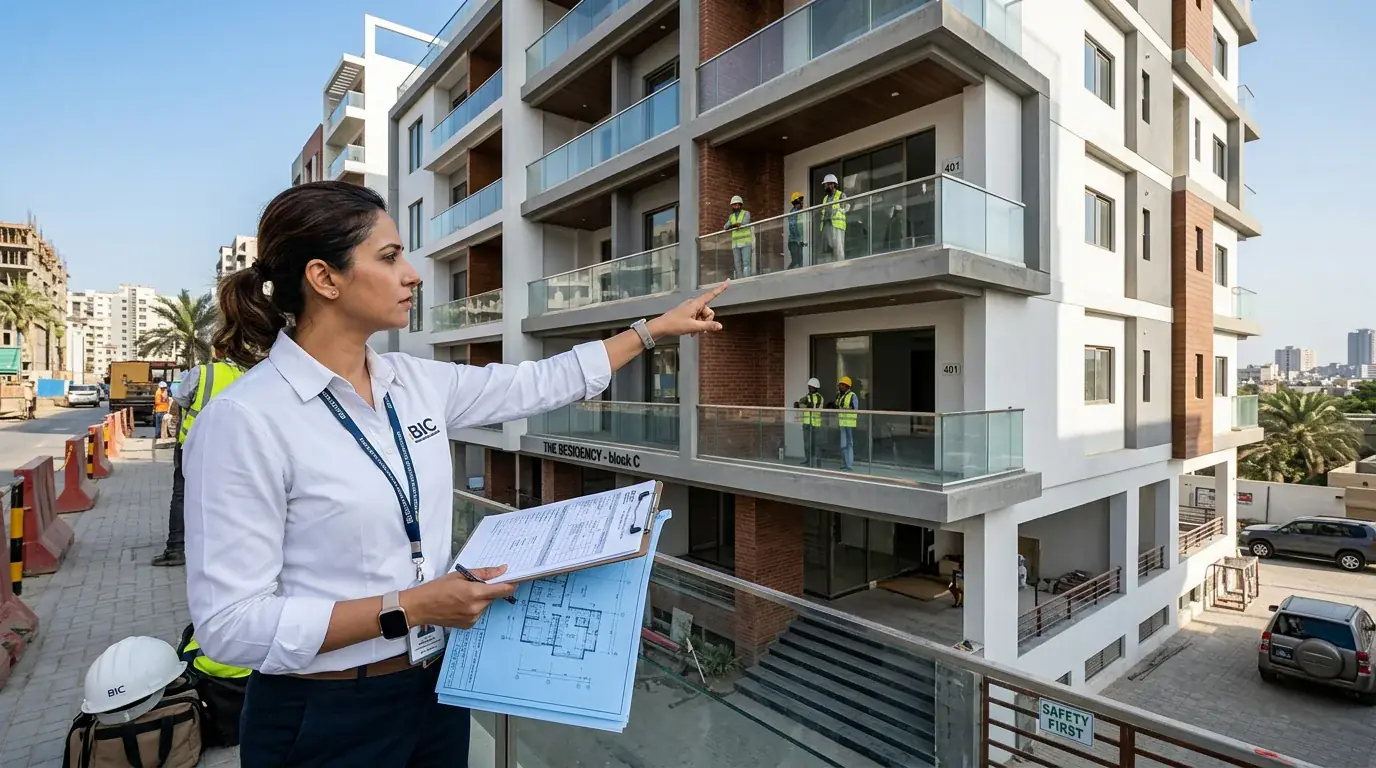
This requires a physical site visit with the certified SBCA blueprints in hand — counting actual constructed slabs against the approved floor index, measuring Compulsory Open Space (COS) setbacks against the approved site plan, and checking for illegal basement conversions, unauthorized commercial shops on stilt parking, or mezzanine additions that do not appear in the sanctioned drawings.
| Verification Track | Governing Authority | Key Documents | Verification Portal / Counter |
|---|---|---|---|
| Track 1: Land Ownership & Title | KDA / MDA / LDA / DHA / Cantonment / BOR | Allotment Order, Lease Deed (Form B), Mutation Orders, NEC | KDA Land Dept / sindhzameen.gos.pk / DHA Transfer Office / Cantonment MEO |
| Track 2: Structural & Building Legality | SBCA (under SBCO 1979) | Building Plan Sanction (BPS), NOC for Sale (Sec 5 & 6-A), Completion Certificate (Sec 18-G) | sbca.gos.pk / SBCA Civic Centre One-Window Cell |
| Track 3: Physical On-Site Cross-Audit | Buyer / Independent Structural Advisor | Certified SBCA blueprints vs. actual construction | Physical site inspection with certified drawings |
For a broader overview of the complete property buying process in Karachi, including negotiation, documentation, and registration steps, see the MaxX Capitals Buying Property in Karachi: A Step-by-Step Buyer’s Guide.
3. The Three Critical SBCA Instruments Every Buyer Must Distinguish
Many buyers — and even some brokers — treat “SBCA approved” as a single binary status. It is not. There are three distinct SBCA instruments under SBCO 1979, each confirming something different and each carrying different legal weight.
Building Plan Sanction (BPS) Under Section 6(1) SBCO 1979 — What It Approves and What It Does Not Permit
A Building Plan Sanction (BPS) is SBCA’s approval of the architectural, structural, and MEP (mechanical, electrical, plumbing) blueprints submitted by the developer’s licensed architect. It confirms that the proposed design complies with Floor Area Ratio (FAR) limits, Compulsory Open Space (COS) requirements, height restrictions, and zoning bylaws for that specific plot.
What a BPS does NOT authorize: A BPS does not permit the developer to advertise the project, market units to the public, or collect any booking advance or installment money from buyers. A developer who markets a project on the strength of a BPS alone — without a NOC for Sale — is operating in violation of Section 5 of SBCO 1979.
NOC for Sale and Advertisement Under Sections 5 and 6-A — The Mandatory Pre-Booking Permit
The NOC for Sale and Advertisement is the instrument that legally authorizes a developer to market a multi-story residential or commercial project to the public and collect installment payments. Under Section 5 of SBCO 1979, any agreement, booking, or collection of money from the public without an active, validated NOC for Sale is illegal and voids the statutory protections that would otherwise apply to buyers.
To obtain this NOC, the developer must demonstrate clear land title, submit bank guarantees, and have an active Building Plan Sanction in place. This is the single most important document to verify before paying any booking advance on an off-plan apartment project in Karachi. The SBCA NOC check Karachi process begins here.
Completion and Occupancy Certificate Under Section 18-G — The Utility Connection Gate and Sub-Lease Prerequisite
The Completion Certificate (also called the Occupancy Certificate) is issued by SBCA after a physical on-site inspection confirms that the as-built construction matches the sanctioned drawings. This certificate is the gateway to two critical post-construction rights:
- Permanent Utility Connections: Under Section 18-G, K-Electric, SSGC, and KW&SC are legally barred from granting permanent residential or commercial connections to multi-story buildings without a verified Completion Certificate.
- Registered Sub-Lease Execution: The Sub-Registrar requires a Completion Certificate before registering individual unit sub-leases in buyers’ names. Without it, buyers cannot obtain clean registered title to their individual apartments.
| SBCA Instrument | Governing Section (SBCO 1979) | What It Confirms | What It Does NOT Guarantee |
|---|---|---|---|
| Building Plan Sanction (BPS) | Section 6(1) | Design compliance with FAR, COS, height, and zoning bylaws | Permission to market, sell, or collect money from public |
| NOC for Sale & Advertisement | Sections 5 & 6-A | Developer’s legal authorization to market and collect installments | That construction will match the approved plan |
| Completion & Occupancy Certificate | Section 18-G | As-built construction matches sanctioned drawings | Clean land title or absence of encumbrances on the plot |
4. Karachi’s Jurisdictional Map: When SBCA Applies and When It Does Not
One of the most dangerous knowledge gaps in Karachi’s property market is the assumption that SBCA governs all construction across the city. It does not. Karachi has multiple independent building control authorities operating in parallel, and presenting an SBCA document for a property inside DHA or a Cantonment Board area is a jurisdictional mismatch — and a potential fraud indicator.
KDA, MDA, LDA, and Cooperative Society Schemes — SBCA’s Primary Operating Territory
SBCA’s primary jurisdiction covers KDA schemes (Gulshan-e-Iqbal, North Nazimabad, Clifton blocks under KDA, Korangi), MDA schemes (Scheme 45, Taiser Town, New Malir), LDA schemes (Hawkesbay Scheme 42), and cooperative housing societies (PECHS, SMCHS, KDA Officers Society, Scheme 33 societies). In all these areas, building plan approvals, NOCs for Sale, and Completion Certificates are issued by SBCA.
DHA Karachi Phases 1–8 — Entirely Independent Building Control with Zero SBCA Authority
DHA Karachi operates its own independent building control system through its Directorate of Planning and Architecture. DHA issues its own building plan approvals, construction NOCs, and completion certificates. SBCA has absolutely zero jurisdiction inside DHA Karachi Phases 1 through 8. A seller presenting an SBCA document for a DHA property should be treated as a serious red flag requiring immediate clarification. For a detailed analysis of how this plays out in a specific DHA-adjacent project, see the MaxX Capitals verified analysis of Greens 3 Clifton Block 8, which illustrates exactly which documents to request in boundary-area projects.
Cantonment Boards (CBC Clifton, Karachi Cantt, Malir Cantt, Faisal Cantt) — Federal Jurisdiction Under Cantonments Act 1924
Properties within Cantonment Board limits — including Clifton Cantonment Board (CBC), Karachi Cantonment, Malir Cantonment, and Faisal Cantonment — fall under federal jurisdiction governed by the Cantonments Act 1924. Building permissions are issued by the respective Cantonment Board’s Engineering Branch, not SBCA. Title verification is conducted through the Military Estate Officer (MEO) and the relevant Cantonment Board records.
Sindh Board of Revenue and Rural Deh Land — Title Verification via sindhzameen.gos.pk Before SBCA Applies
For properties on rural or deh land under the Sindh Board of Revenue (BOR), the primary title is established through registered Sale Deeds, Fard (Form VII) records, and Intiqal entries verified via the Sindh Zameen portal (sindhzameen.gos.pk) using the LARMIS system. Once such land is formally converted and leased for township or construction purposes, SBCA’s jurisdiction for building approvals then applies.

| Land Authority / Micro-Market | Who Verifies Ownership & Title? | Who Issues Building NOCs? | Key Caveats |
|---|---|---|---|
| KDA Schemes (Gulshan, N. Nazimabad, Clifton KDA blocks, Korangi) | KDA Land Department | SBCA | Title at KDA counter; building NOC at SBCA Civic Centre |
| MDA Schemes (Scheme 45, Taiser Town, New Malir) | Malir Development Authority (MDA) | SBCA | Watch for unapproved private societies inside MDA master-planning without SBCA NOC |
| LDA Schemes (Hawkesbay Scheme 42) | Lyari Development Authority (LDA) | SBCA | Land records at LDA; building permissions regulated by SBCA |
| DHA Karachi (Phases 1–8) | DHA Transfer & Record Office | DHA Directorate of Planning & Architecture | SBCA has ZERO jurisdiction inside DHA Karachi |
| Cantonment Boards (CBC, Karachi Cantt, Malir Cantt, Faisal Cantt) | Cantonment Board / Military Estate Officer (MEO) | Cantonment Board Engineering Branch | Federal jurisdiction under Cantonments Act 1924; SBCA does not apply |
| Cooperative Societies (PECHS, SMCHS, Scheme 33 societies) | Society Office + Registrar of Cooperative Societies | SBCA | Society issues NDC; SBCA regulates multi-story NOCs |
| Sindh BOR / Rural Deh Land | Sub-Registrar / Mukhtiarkar / Patwari via sindhzameen.gos.pk | SBCA (post-conversion) | Primary title via Fard and Intiqal; SBCA applies after land conversion |
5. Digital Pre-Screening: How to Use sbca.gos.pk and sindhzameen.gos.pk Before Visiting Any Counter
Before spending time and money on physical counter visits, complete the digital pre-screening phase. This takes 30–60 minutes and can immediately identify disqualifying red flags.
Navigating the SBCA Public Portal — Locating Public Sale Projects, NOC Numbers, and the Blacklisted Developers Register
The SBCA official portal (sbca.gos.pk) maintains publicly accessible registers under the Statistics and Public Notices sections. Here is the step-by-step navigation:
- Go to sbca.gos.pk and navigate to the Statistics or Public Notices section.
- Select Public Sale Projects (Buildings) for apartment and commercial plaza projects, or Public Sale Projects (Housing Schemes) for plotted township developments.
- Filter by year to locate active and historical NOC entries from 2020 through 2026.
- Cross-verify the exact NOC Number, the sanctioned floor configuration (e.g., Basement + Ground + 8 Upper Floors), and the developer’s registration status.
- Check the Illegal Schemes / Blacklisted Developers register to confirm the project is not under active sealing orders, show-cause notices, or stop-work directives.
💡 Red Flag Callout: If a project name or developer does not appear in the SBCA Public Sale Projects register at all, that is not a neutral finding — it is a warning. It may mean the developer is marketing without a valid NOC for Sale, which is a Section 5 violation. Do not proceed to payment until the NOC is physically verified at the Civic Centre counter.
Verifying Land Ownership via LARMIS on sindhzameen.gos.pk — Registered Deeds, Fard Records, and Sub-Registrar Filings
For properties on KDA, MDA, or BOR land, the Sindh Board of Revenue’s LARMIS (Land Administration & Revenue Management Information System) on sindhzameen.gos.pk allows digital pre-screening of:
- Registered sale deeds and conveyance documents filed at the Sub-Registrar.
- Microfilmed registry records for older properties.
- Fard e-records (Form VII) confirming current ownership entries.
- Sub-Registrar registration numbers to cross-verify against physical documents presented by the seller.
Use the Survey Number, Deh, and Sub-Registrar registration details from the seller’s documents to run this check. A mismatch between the seller’s claimed ownership and the LARMIS record is an immediate stop-payment trigger.
6. Physical Verification at the SBCA Civic Centre One-Window Cell: Documents, Fees, and Timelines
Digital pre-screening is necessary but not sufficient. Physical counter verification at SBCA is the only way to obtain a certified, stamped status report that carries legal weight.
Location, Counter Hours, and How to Submit a Certified True Copy Application
The SBCA One-Window Facility is located at the SBCA Headquarters, Annexe Building, Civic Centre, University Road, Gulshan-e-Iqbal, Karachi. The One-Window Cell handles Certified True Copy (CTC) applications for sanctioned building plans and status reports during standard government working hours (Monday through Friday, 9:00 AM to 4:00 PM, excluding public holidays).
Procedure: 1. Arrive at the One-Window Cell with your application documents (see required documents table below). 2. Submit a formal written application requesting a Certified True Copy (CTC) of the sanctioned building plan and a current status report for the specific plot/building. 3. Proceed to the on-site National Bank of Pakistan (NBP) counter to pay the official scrutiny challan fee. 4. Receive a file reference number and processing acknowledgment slip. 5. Return after the standard processing window to collect the stamped status report and certified plan.
Official Challan Fees at the NBP On-Site Counter — PKR 2,000 to PKR 5,000 for Residential; Per-Sq-Ft Rate for Multi-Story Buildings
Government challan fees for CTC applications at SBCA are nominal: – Standard residential plot (single or double storey): PKR 2,000 to PKR 3,000. – Multi-story residential or commercial building: Fees are calculated on a per-gross-covered-sq-ft basis, typically ranging from PKR 3,000 to PKR 5,000 for mid-rise buildings. Larger commercial towers may attract higher fees based on total covered area.
These fees are subject to revision by SBCA’s fee schedule. Always confirm the current rate at the NBP counter before submitting payment.
What the Stamped Status Report and Certified Plan Confirm — and the Standard 7–14 Working Day Processing Window
The stamped status report issued by SBCA’s technical directorate confirms: – The approved floor configuration (e.g., 1 Basement + Ground + 7 Upper Floors). – The current NOC for Sale status (active, expired, cancelled, or under show-cause). – Any active stop-work orders, Section 7-A show-cause notices, or sealing directives on file. – The name of the registered developer/owner on the SBCA file.
Standard processing timeline: 7 to 14 working days from submission date. Urgent processing may be available through formal written request, subject to SBCA’s discretion.
💡 Senior Property Advisor Insight — Muhammad Ali Dawood, MaxX Capitals: Never accept a photocopy of an SBCA-stamped plan from a developer or seller as your verification. Photocopies can be forged. The only document that carries legal weight is a fresh Certified True Copy issued directly by SBCA’s One-Window Cell with the current date, official stamp, and file reference number cross-verified against the physical archive. This single step has saved our clients from multiple fraudulent transactions in Gulshan and Clifton.

| Required Document | Purpose |
|---|---|
| Copy of seller’s title deed / allotment letter | Identifies the plot and registered owner for SBCA file search |
| Plot number, survey sheet, and block/scheme details | Enables SBCA to locate the correct physical archive file |
| CNIC copy of applicant (buyer or authorized representative) | Identity verification for CTC issuance |
| Written application letter (addressed to Director General, SBCA) | Formal request for CTC and status report |
| NBP challan receipt | Proof of fee payment |
7. The 20–30 Year Land Title Chain Search: Documents That Must Be Present Before Any Token Payment
SBCA property title verification Karachi is only half the due-diligence equation. The land title chain search is equally critical and must be completed independently.
Allotment Order, Possession Order, and the Registered 99-Year Lease Deed (Form B)
The foundation of any Karachi property title is the original Allotment Order from the primary lessor (KDA, MDA, DHA, or relevant authority), followed by the Possession Order confirming physical handover of the plot. The Registered 99-Year Lease Deed (Form B) is the formal legal instrument that establishes the lessee’s rights over the plot. All three documents must be original or certified copies — not photocopies.
Mutation Orders, Registered Sale Deeds, and the Unbroken Chain of Conveyance
Every subsequent transfer of ownership must be documented through a chain of registered Sale Deeds (executed at the Sub-Registrar’s office) and corresponding Mutation Orders (Intiqal) in the lessor authority’s records. A gap in this chain — a missing sale deed, an unregistered transfer, or a mutation that was never formally recorded — is a serious title defect that can expose the buyer to competing ownership claims.
Non-Encumbrance Certificate (NEC) from the Sub-Registrar — Confirming No Active Mortgage, Court Attachment, or Charge
The Non-Encumbrance Certificate (NEC) is issued by the Sub-Registrar’s office and confirms that as of the date of issuance, no mortgage, bank charge, court attachment, or encumbrance is registered against the property in the Sub-Registrar’s records. This is a mandatory document before any token payment. An NEC is typically valid for 30 days from the date of issuance.
Property Tax, Betterment Tax, and CVT Challans as Supporting Proof of Legitimate Ownership History
Paid property tax challans (issued by the Sindh Revenue Board / Excise & Taxation Department), betterment tax receipts, and Capital Value Tax (CVT) challans serve as supporting evidence of continuous, legitimate ownership. Gaps in tax payment history — particularly for properties that have been vacant or where the seller claims recent inheritance — warrant additional scrutiny. For FBR-related tax obligations on property transactions, refer to the Federal Board of Revenue (FBR) portal (fbr.gov.pk) for current advance tax and CVT rates applicable to property transfers.
| Document Name | Issuing Authority | What It Confirms | Red Flag if Missing |
|---|---|---|---|
| Allotment Order | KDA / MDA / DHA / Relevant Authority | Original grant of plot to first allottee | No legal basis for any subsequent title |
| Possession Order | Same as Allotment Authority | Physical handover of plot to allottee | Title chain is incomplete from the start |
| Registered Lease Deed (Form B) | Sub-Registrar (on behalf of lessor) | Formal 99-year leasehold rights | No registered leasehold; title is unenforceable |
| Chain of Mutation Orders (Intiqal) | KDA / MDA / Lessor Authority Records | Each ownership transfer recorded in official register | Gap in chain = competing ownership risk |
| Registered Sale Deeds | Sub-Registrar | Each buyer-to-buyer transfer legally documented | Unregistered transfers are legally void |
| Non-Encumbrance Certificate (NEC) | Sub-Registrar | No active mortgage, charge, or court attachment | Property may be pledged to a bank or under court stay |
| Property Tax Challans | Sindh Revenue Board / Excise & Taxation | Continuous legitimate ownership history | Possible ownership dispute or abandoned property |
| CVT / Betterment Tax Receipts | FBR / Sindh Revenue Board | Tax compliance on property value | Potential FBR liability transferred to buyer |
8. On-Ground Physical Site Audit: Cross-Checking Sanctioned Blueprints Against Actual Construction
Once you have the certified SBCA blueprints in hand, the physical site audit is the final verification layer before committing to any payment.
How to Count Physical Slabs and Compare Against the Approved Floor Index on Certified Drawings
Stand at street level and count the physical floor slabs of the building. Compare this count against the approved floor index on the SBCA certified drawings (e.g., “1 Basement + Ground Floor + 8 Upper Floors = 10 total levels”). Any additional slab above the sanctioned height limit is an unauthorized floor — a non-compoundable violation under Section 19 of SBCO 1979 that cannot be regularized and is subject to mandatory demolition.
Measuring Compulsory Open Space (COS) Setbacks and Identifying Encroachments
The sanctioned building plan specifies mandatory Compulsory Open Space (COS) setbacks on all sides of the building. Walk the perimeter of the building and check whether the physical structure respects these setbacks or whether construction has encroached onto the COS. COS encroachment is a non-compoundable violation.
Spotting Illegal Basement Conversions, Unauthorized Commercial Shops on Stilt Parking, and Mezzanine Additions
Three of the most common physical violations in Karachi’s mid-rise residential buildings are: – Basement conversions: Sanctioned as parking or utility space but converted into commercial shops or residential units. – Stilt parking commercialization: Ground-floor stilt parking mandated in the approved plan converted into retail shops. – Mezzanine additions: Unauthorized half-floors inserted between sanctioned floors to increase sellable area.
All three are non-compoundable violations. Buyers who purchase units in buildings with these violations inherit the legal exposure.
Compoundable vs. Non-Compoundable Violations Under Section 19 SBCO 1979 — What Can Be Regularized and What Faces Mandatory Demolition
| Violation Type | Category | Real Karachi Examples | Legal Consequence |
|---|---|---|---|
| Minor room dimension variation (within 5%) | Compoundable | Slightly enlarged bedroom in a Gulshan apartment | Regularized on payment of prescribed penalty |
| Interior partition layout change | Compoundable | Relocated kitchen wall in a Clifton flat | Regularized on payment of prescribed penalty |
| Unauthorized floor(s) above sanctioned height | Non-Compoundable | Extra 2 floors on a Nazimabad 6-storey building | Mandatory demolition; no regularization possible |
| COS setback encroachment | Non-Compoundable | Building extending into mandatory open space in PECHS | Mandatory demolition of encroaching portion |
| Stilt/basement parking converted to commercial | Non-Compoundable | Ground-floor shops in place of mandated parking in Saddar | Mandatory demolition; SHC has enforced this repeatedly |
| Construction on amenity / ST plot | Non-Compoundable | Building on a park reservation in Scheme 33 | Mandatory demolition; cannot be regularized under any provision |
💡 Senior Property Advisor Insight: The Sindh High Court has issued demolition orders against non-compoundable violations across Gulshan, Clifton, Nazimabad, and Saddar with increasing frequency since 2023. The Federal Constitutional Court’s July 2026 ruling strengthened due-process protections for bona-fide purchasers — but it did not protect buyers who failed to conduct basic SBCA property title verification Karachi before committing funds. The due-process protection applies to the demolition execution procedure, not to the underlying violation itself.
9. Common SBCA Red Flags, Fraud Traps, and the Five Hard Stop-Payment Triggers
Five Karachi Property Scams Mapped to Their Legal Vulnerability and Detection Method
| Scam Type | Underlying Legal Vulnerability | How to Detect | Advisory Action |
|---|---|---|---|
| Over-Constructed Floors (e.g., 8 floors built on a 4-floor sanction) | Upper floors have zero legal standing; no sub-leases, no individual utility meters; subject to demolition | Count physical slabs on site; compare against certified SBCA floor index | Immediate Stop-Payment: Never buy a top-floor or mezzanine unit without verifying its floor index in the sanctioned plan |
| “NOC Under Process” Claim | Section 5 SBCO 1979 forbids marketing or collecting booking advances without a signed, active NOC for Sale | Request the certified NOC number; verify on sbca.gos.pk Public Sale Projects register | Walk Away: Refuse any token payment until developer produces certified copy of the approved NOC for Sale |
| Amenity / ST Plot Encroachment | Structure built on public amenity land (parks, sewage lines, school reservations); non-compoundable | Review Master Layout Plan at KDA / master-planning directorate and land survey sheets | Demand certified zoning status; amenity plots can never be legally regularized under any provision |
| Missing Completion Certificate on Ready Flats | Building occupied but developer failed to obtain final inspection sign-off; utility lines on temporary bulk rates | Check with SBCA Zonal Director; ask seller for physical Occupancy Certificate | Buyers cannot execute registered sub-lease; face disconnection risk; negotiate price reduction or walk away |
| Forged SBCA Stamped Blueprint | Unscrupulous sellers produce photocopies of fake architect stamps and forged SBCA letters | Verify the reference file number directly at Civic Centre One-Window Cell archives | Never accept photocopies alone; demand a fresh certified status report issued directly by SBCA |
🛑 The Five Hard Stop-Payment Triggers — When to Pause the Deal Immediately Regardless of Seller Pressure
These five triggers are non-negotiable. If any one of them is present, pause all payments immediately and do not proceed until the issue is fully resolved with verified documentation:
🛑 STOP-PAYMENT TRIGGER 1: The seller or developer refuses to provide the original title deed chain or the SBCA file reference number for independent verification at the Civic Centre counter.
🛑 STOP-PAYMENT TRIGGER 2: The property is located inside DHA Karachi or a Cantonment Board area, but the seller is presenting an SBCA document as the building approval authority — a jurisdictional mismatch that indicates either ignorance or deliberate misrepresentation.
🛑 STOP-PAYMENT TRIGGER 3: The SBCA online portal (sbca.gos.pk) or the Civic Centre physical register shows active Section 7-A show-cause notices, stop-work orders, or sealed status against the building or developer.
🛑 STOP-PAYMENT TRIGGER 4: The physical building on site has more floors than what is endorsed on the sanctioned blueprint — meaning the upper floors (including the unit being sold) have no legal standing and face demolition exposure.
🛑 STOP-PAYMENT TRIGGER 5: The seller is transacting on a Power of Attorney (POA) that is unregistered, has expired, has been cancelled, or where the principal owner is deceased — making the POA legally void and the transaction unenforceable.
10. How MaxX Capitals Audits Property Titles Before You Commit: Advisory Summary and Next Steps
The Four-Phase Pre-Purchase Due-Diligence Framework MaxX Capitals Applies on Every Advisory Mandate
At MaxX Capitals, every property advisory mandate — whether for a PKR 80 lakh apartment in Gulshan or a PKR 4 crore penthouse in Clifton — follows the same four-phase due-diligence framework before we recommend a client commit any funds:
Phase 1 — Digital Pre-Screening (1–2 Days) – SBCA portal check for NOC for Sale status, floor sanction, and blacklist register. – sindhzameen.gos.pk LARMIS check for registered deeds and ownership records. – FBR portal check for advance tax and CVT compliance status.
Phase 2 — Physical Counter Verification (7–14 Working Days) – Submission of CTC application at SBCA Civic Centre One-Window Cell. – Title chain document review at KDA / MDA / relevant lessor authority. – NEC application at Sub-Registrar’s office.
Phase 3 — On-Ground Physical Site Audit (1 Day) – Physical floor count against certified SBCA blueprints. – COS setback measurement and encroachment check. – Utility connection status verification (K-Electric, SSGC, KW&SC).
Phase 4 — Legal Review and Transaction Structuring (2–5 Days) – Independent property lawyer review of title chain and sale agreement. – Payment plan structuring tied to construction milestones and NOC status. – Final go/no-go recommendation to the client.
When to Engage a Property Lawyer Alongside a Real Estate Advisor — and What Each Role Covers
A real estate advisor and a property lawyer serve complementary but distinct roles in the due-diligence process. MaxX Capitals handles the market intelligence, SBCA verification, site audit, and investment analysis. A qualified property lawyer handles the legal interpretation of title documents, drafting of sale agreements, Sub-Registrar registration, and any litigation risk assessment. For transactions above PKR 1 crore, or for any property with a complex title history, engaging both is not optional — it is standard practice.
For a comprehensive walkthrough of the full property transaction process in Karachi — from initial search through registration — the MaxX Capitals Buying Property in Karachi: A Step-by-Step Buyer’s Guide covers the complete sequence. To see how this due-diligence framework applies to a specific live project, the Greens 3 Clifton Block 8 verified analysis demonstrates the exact documents MaxX Capitals requested and verified before advising clients on that project.
Conclusion: Verification First, Transaction Second
SBCA property title verification Karachi is not a bureaucratic formality — it is the foundation of every sound property transaction in this city. The dual-track framework outlined in this guide — separating land ownership verification from structural building legality, and cross-checking both against the physical reality on the ground — addresses the single most dangerous knowledge gap in Karachi’s property market.
The three SBCA instruments (Building Plan Sanction, NOC for Sale, and Completion Certificate) are not interchangeable. The jurisdictional map is not uniform — DHA and Cantonment areas operate entirely outside SBCA’s authority. The five stop-payment triggers are not suggestions — they are hard boundaries that protect your capital from fraud, demolition exposure, and title disputes that can take years and significant legal costs to resolve.
Before signing any agreement or paying any token, ensure your SBCA status report is certified and current, your Non-Encumbrance Certificate is dated within 30 days, and your title chain is unbroken from the original allotment to the current seller. If any document is missing, any verification is refused, or any jurisdictional mismatch appears — pause the transaction and seek independent advisory before proceeding.
Ready to Navigate Your Next Property Decision?
Before committing booking money or signing builder agreements, ensure your paperwork, approvals, and installment structures are verified.

Muhammad Ali Dawood
Official AdvisorFrequently Asked Questions
Does an SBCA-approved building plan mean the land title is legally clear and free from disputes?
No. An SBCA Building Plan Sanction (BPS) confirms only that the proposed design complies with building bylaws and zoning regulations. It does not verify land ownership, confirm the absence of mortgages or court attachments, or guarantee that the developer holds clear title to the plot.
Land title verification is a completely separate process conducted through the primary lessor authority (KDA, MDA, DHA, or Cantonment Board) and the Sub-Registrar's office. A developer can obtain a valid SBCA BPS on land that is disputed, mortgaged, or subject to a court stay order. Always conduct both tracks independently before committing any funds.
How do I check if a Karachi apartment project has a valid NOC for Sale and Advertisement on the SBCA website?
Visit sbca.gos.pk, navigate to the Statistics or Public Notices section, and open the Public Sale Projects (Buildings) register. Search for the project by developer name or NOC number. Verify the NOC number, sanctioned floor configuration, and active status.
If the project does not appear in the register, or if the NOC shows as expired or cancelled, the developer is not legally authorized to collect booking advances under Section 5 of SBCO 1979. Follow up with a physical CTC application at the SBCA Civic Centre One-Window Cell to obtain a stamped status report before making any payment decision.
Does SBCA have any authority inside DHA Karachi or Clifton Cantonment Board areas?
No. SBCA has zero jurisdiction inside DHA Karachi (Phases 1–8) or any Cantonment Board area (CBC Clifton, Karachi Cantt, Malir Cantt, Faisal Cantt). DHA operates its own independent building control through its Directorate of Planning and Architecture. Cantonment Boards operate under the federal Cantonments Act 1924.
If a seller presents an SBCA document as the building approval authority for a property inside DHA or a Cantonment, treat this as a jurisdictional mismatch and a potential red flag. Verify building approvals directly with DHA's Transfer Office or the relevant Cantonment Board Engineering Branch.
What is the difference between a Building Plan Sanction and an SBCA NOC for Sale under SBCO 1979?
A Building Plan Sanction (BPS) under Section 6(1) approves the architectural and structural design of a building. A NOC for Sale under Sections 5 and 6-A is a separate, subsequent permit that authorizes the developer to market the project and collect installment payments from the public.
A BPS alone does not permit any marketing or collection of funds. Developers who market projects with only a BPS — claiming the NOC is "under process" — are in violation of Section 5 of SBCO 1979. Any booking made without an active NOC for Sale lacks the statutory protections that SBCO provides to buyers.
Can K-Electric or SSGC legally refuse a permanent connection to a building without an SBCA Completion Certificate?
Yes. Under Section 18-G of SBCO 1979, K-Electric, SSGC, and KW&SC are legally barred from granting permanent residential or commercial utility connections to multi-story buildings that do not hold a valid SBCA Completion Certificate.
Buildings without Completion Certificates typically operate on temporary bulk commercial connections arranged by the developer — which are more expensive, less reliable, and cannot be transferred to individual unit owners. Buyers in such buildings cannot get individual utility meters in their own names, which also prevents execution of registered sub-leases at the Sub-Registrar.
What documents do I need to bring for physical verification at the SBCA One-Window Cell at Civic Centre Karachi?
Bring a copy of the seller's title deed or allotment letter, the plot number and scheme/block details, a copy of your CNIC, a formal written application addressed to the Director General SBCA requesting a Certified True Copy and status report, and payment for the NBP challan fee (PKR 2,000 to PKR 5,000 for standard residential).
The SBCA technical directorate will use the plot details to locate the physical archive file and blueprints. Processing takes 7 to 14 working days. Collect the stamped status report and certified plan in person — do not accept delivery through a third party without verifying the document's authenticity against the file reference number.
What is a Non-Encumbrance Certificate (NEC) and which authority issues it in Karachi?
A Non-Encumbrance Certificate (NEC) is an official document issued by the Sub-Registrar's office confirming that no mortgage, bank charge, court attachment, or encumbrance is registered against a specific property as of the date of issuance. It is valid for approximately 30 days.
In Karachi, NECs are issued by the relevant Sub-Registrar's office based on the property's location and registration jurisdiction. The NEC is a mandatory document in any property due-diligence process — it is the only way to confirm that the seller has not pledged the property as collateral for a bank loan or that the property is not under a court-ordered attachment. Never pay a booking advance without a current NEC.
If a developer says the SBCA NOC is "under process," can I legally pay a booking advance?
No. Under Section 5 of SBCO 1979, a developer is legally prohibited from collecting any booking advance, token payment, or installment from the public for a multi-story residential or commercial project without a signed, active NOC for Sale and Advertisement.
"Under process" is not a legally valid status for collecting public funds. If you pay a booking advance on this basis, you lose the statutory protections that SBCO provides to buyers — including the bank guarantee requirement and the developer's legal accountability under the NOC framework. Refuse all payments until the developer produces a certified copy of the approved NOC with a valid NOC number verifiable on sbca.gos.pk.
What happens to buyers who purchased floors in a building that was later found to have unauthorized construction above the sanctioned height limit?
Buyers who purchased units on unauthorized floors face demolition exposure, permanent inability to obtain registered sub-leases, and no access to individual utility connections. They cannot sell to bank-financed buyers and have limited legal recourse if the developer's NOC for Sale was absent at the time of booking.
The Federal Constitutional Court's July 2026 ruling strengthened due-process protections for bona-fide purchasers in demolition proceedings — requiring strict adherence to Section 7-A show-cause procedures before execution. However, this protection applies to the demolition process, not to the underlying violation. Buyers in unauthorized floors remain in a legally precarious position regardless of due-process protections. Prevention through SBCA property title verification Karachi before payment is the only reliable safeguard.



Join The Discussion