

 by
by 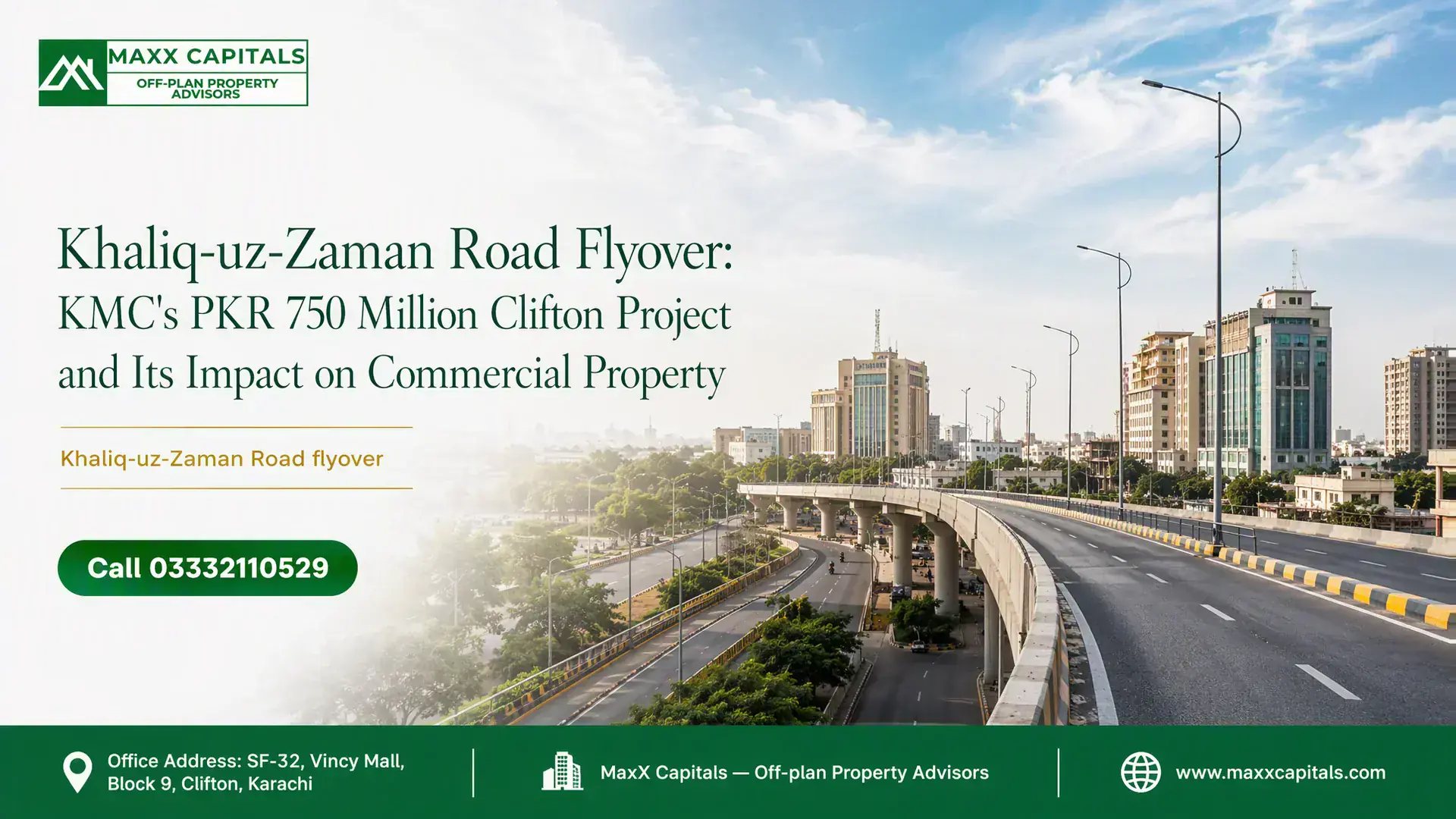
The proposed Khaliq-uz-Zaman Road flyover has placed one of Clifton Block 8’s busiest mixed-use corridors under fresh investor scrutiny. On August 28, 2026, the Karachi Metropolitan Corporation listed an official notification stating that it intends to construct a flyover on Chaudhry Khaliq-uz-Zaman Road in Clifton Block 8, District South.
Published reports place the proposed cost at approximately PKR 750 million and identify the location near Saylani Welfare Trust. However, as of the September 3, 2026 research cut-off for this analysis, the public material reviewed does not establish a contractor appointment, final engineering dimensions, approved traffic-diversion plan, construction commencement date or contractual completion period.
That distinction matters. A public notice is evidence that KMC has started the pre-construction consultation process; it is not evidence that excavation will begin immediately. Commercial owners, tenants and prospective investors should therefore prepare for disruption without pricing an uncertain construction schedule as a confirmed event.
Key Takeaways — Executive Summary
Primary Insight: KMC officially listed its project notice on August 28, 2026 and invited affected parties to submit observations or objections within seven days.
Financial Impact: Our scenario model indicates that directly obstructed retail units could face temporary effective-rent pressure of 15%–25%, but this is an advisory range rather than a confirmed market-wide decline.
Legal Check: Verify the final KMC scheme, traffic-management plan, utility-relocation plan, land requirements and access treatment before signing a long lease or buying roadside commercial space.
Actionable Recommendation: Existing owners should preserve occupancy through temporary rent restructuring. Buyers should negotiate against construction risk but avoid paying today for an unconfirmed post-completion price increase.
Table of Contents
1. KMC’s PKR 750 Million Infrastructure Gamble
Why This Flyover Matters for Clifton’s Commercial Corridor
Chaudhry Khaliq-uz-Zaman Road is not merely a neighbourhood street. It provides movement between Clifton, Bath Island, Cantt-side approaches and routes leading towards DHA. Karachi Traffic Police has also used the road as an alternative corridor during temporary diversions around Teen Talwar and Clifton Bridge, demonstrating its role in the wider road network. (tribune.com.pk)
The proposed site near Saylani Welfare Trust sits within a dense commercial environment containing offices, clinics, banks, restaurants, convenience retail, service businesses and residential buildings with ground-floor commercial activity. Many occupiers depend on three factors:
- direct vehicle access;
- visible signage from the main road;
- short-duration roadside stopping or nearby parking.
Flyover construction can interfere with all three before producing any traffic benefit. Barricades may obscure storefronts, excavation can interrupt frontage access, and diverted traffic may stop passing the affected businesses altogether.
Investors examining property along the corridor should first review MaxX Capitals’ Khaliq Uz Zaman Road area archive to understand the road as a complete commercial micro-market rather than evaluating a unit in isolation.
What Property Owners and Investors Need to Know
The verified event is the August 28, 2026 public notice, not the start of physical construction. KMC’s official notifications page records its intention to construct the flyover in Block 8, Clifton. Secondary reporting states that departments, organisations and affected owners were given seven days to send objections or observations to the Chief Engineer responsible for bridges, underpasses and flyovers. (pcq.com.pk)
This produces three separate planning stages:
| Stage | Verified Status on September 3, 2026 | Investor Interpretation |
|---|---|---|
| Public notice and objection process | Confirmed | Pre-construction consultation is active |
| Final design, tender and contractor appointment | Not established in reviewed public material | Do not treat construction mobilisation as confirmed |
| Road closures and physical work | Not established | Model disruption scenarios, not fixed dates |
| Completion and operational opening | No verified date available | Do not price a completion premium into acquisition decisions |
The reported PKR 750 million figure should also be treated as a preliminary project estimate until it appears in a final tender, sanctioned scheme or contract award. Project costs may change after utility mapping, design revisions, price escalation and traffic-management requirements.
2. Project Blueprint: What KMC Is Actually Building
Flyover Design Specifications and Traffic-Flow Engineering
The official notice confirms KMC’s intent and location, but the reviewed public record does not provide enough detail to state the flyover’s final length, width, number of lanes, pier locations, ramp gradients or construction method.
A responsible property assessment must therefore separate confirmed facts from missing engineering information.
| Project Parameter | Current Position |
|---|---|
| Implementing body | Karachi Metropolitan Corporation |
| Department | KMC Engineering Department |
| Location | Chaudhry Khaliq-uz-Zaman Road, Block 8, Clifton, District South |
| Reference point | Near Saylani Welfare Trust |
| Public notice date | August 28, 2026 |
| Reported estimated cost | Approximately PKR 750 million |
| Final length and width | Not verified in reviewed public material |
| Lane configuration | Not verified |
| Pier and ramp locations | Not verified |
| Contractor | Not verified |
| Construction start | Not announced in reviewed material |
| Contract period | Not announced in reviewed material |
| Traffic-diversion plan | Not publicly established in reviewed material |
KMC maintains a substantial network of bridges, flyovers and underpasses across Karachi, including Clifton’s existing steel flyover and KPT-linked infrastructure. Its official infrastructure inventory confirms that elevated road construction is within KMC’s operational scope. (kmc.gos.pk)
For nearby property, pier and ramp placement will matter more than the project’s headline length. A flyover ramp directly outside a shop can limit turning access, interrupt parking and reduce signage visibility. A property located beyond the ramp termination may instead benefit from faster movement and cleaner frontage.
PKR 750 Million Cost Breakdown and Funding Sources
No verified component-level cost breakdown was available in the public sources reviewed. It would therefore be inaccurate to assign specific amounts to concrete, steel, utility relocation, consultancy, land or traffic management.
A final project cost would normally need to account for:
- geotechnical investigations;
- reinforced foundations and piers;
- girders, deck slabs and expansion joints;
- ramps and retaining structures;
- drainage modifications;
- streetlights and safety barriers;
- utility identification and relocation;
- road resurfacing beneath and beside the structure;
- traffic diversions and construction barricades;
- consultant supervision and testing;
- environmental and site-safety controls;
- contingency and price variation.
Property owners should request the approved scheme document and detailed traffic plan rather than relying on the headline budget. The KMC tender portal should also be monitored for a procurement notice, contractor award and completion period. At the research cut-off, the visible tender listings reviewed did not establish a contract award for this specific flyover. (kmc.gos.pk)
3. Public Notice Timeline: Your Window to Object
KMC’s Legal Obligation and the Status of the Notice
The KMC notifications portal records the August 28, 2026 notice for the proposed flyover. The Sindh Local Government Act, 2013 provides the broader legal framework under which local councils perform municipal functions, manage public infrastructure and carry out development responsibilities.
The project-specific seven-day objection window comes from KMC’s notice. Owners should not assume that merely sending an email, social-media comment or verbal complaint preserves their position. A submission should be delivered to the office named in the notice and supported by evidence.
The governing Act can be reviewed through the Government of Sindh’s official legislation portal. Property owners should obtain legal advice before asserting that any particular section creates compensation or cancellation rights.
How Property Owners Can Submit Objections
An effective objection should identify a specific, measurable impact and propose a workable mitigation measure.
- Download or obtain the complete KMC notice.
- Confirm the publication date used to calculate the seven-day period.
- Identify the submitting party, including owner, tenant, association or affected institution.
- Attach title or tenancy evidence connecting the applicant to the affected premises.
- Mark the property on a site plan, Google map printout or survey drawing.
- Describe the anticipated impact, such as blocked entrance, loss of parking, utility interference or unsafe loading access.
- Attach photographs showing current gates, ramps, parking bays and pedestrian movement.
- Request a specific remedy, such as maintaining one entrance, relocating a pier, preserving pedestrian access or scheduling works outside trading hours.
- Submit the package to the office named in the notice.
- Obtain a stamped receiving copy or official diary number.
A broad statement that the flyover may reduce business is weaker than a documented claim showing that a proposed barricade or ramp could block the only approved entry to a property.
Critical Dates and Documentation Requirements
| Action | Date or Timing |
|---|---|
| KMC notice date | August 28, 2026 |
| Reported objection period | Seven days from publication |
| Research cut-off | September 3, 2026 |
| Tender or contractor appointment | Not verified |
| Physical commencement | Not verified |
| Completion | Not verified |
If August 28 is also treated as the operative publication date, the objection window would be close to expiry on September 3–4, 2026. Affected parties should confirm the exact calculation directly with KMC rather than relying solely on this calendar interpretation.
Recommended objection file:
- copy of CNIC or company incorporation documents;
- ownership, allotment, lease or tenancy evidence;
- property tax or utility bill identifying the premises;
- site photographs;
- sanctioned building plan, where relevant;
- entrance and parking layout;
- business operating hours;
- employee and visitor movement estimates;
- requested mitigation measures;
- authority letter where an advocate or representative submits the objection.
4. Construction Phase Reality: Disruption Could Be Significant
Road-Closure Phases and Detour Routes
The blueprint assumption of 24–36 months cannot presently be treated as KMC’s official construction timeline. No final contract period was verified. It is better used as a downside planning range for lease negotiations and business-continuity analysis.
A probable construction sequence may look like this:
| Illustrative Phase | Indicative Activity | Disruption Level |
|---|---|---|
| Pre-mobilisation | Surveying, utility marking, soil testing | Low |
| Utility relocation | Water, sewerage, power or telecom adjustments | Medium to high |
| Barricading and piling | Lane occupation, drilling and heavy machinery | Very high |
| Pier construction | Concrete work and restricted turning movement | High |
| Girder and deck work | Cranes, partial closures and night activity | Very high |
| Ramp and road works | Frontage restrictions and resurfacing | High |
| Finishing and opening | Lighting, barriers, markings and testing | Medium |
This is an advisory sequence, not KMC’s published programme.
Likely diversion options may use Clifton Bridge, Bath Island, Race Course Road, Teen Talwar approaches and connecting internal streets. The final plan must come from KMC and Karachi Traffic Police because improvised diversions can transfer congestion into residential streets and narrow commercial lanes.
Dust, Noise and Heavy Machinery
The most visible cost is congestion, but the less visible costs can be equally damaging:
- dust entering shops, clinics and offices;
- vibration affecting sensitive equipment;
- noise during piling or girder installation;
- blocked loading and delivery windows;
- loss of short-stay parking;
- higher cleaning and maintenance costs;
- longer employee commute times;
- reduced customer willingness to visit;
- drainage obstruction during monsoon periods;
- temporary interruption of utilities.
Restaurants and medical operators are particularly sensitive to dust, access reliability and generator placement. Showrooms suffer when barricades remove drive-by visibility. Offices may remain operational but face staff-retention and visitor-parking pressure.
💡 Senior Property Advisor Insight: Before renewing a lease, photograph all access points and record current travel times during morning, afternoon and evening peaks. This creates a baseline for negotiating temporary relief if construction materially changes access.
Foot-Traffic Impact: Modelling a 60%–70% Reduction
A 60%–70% decline should not be presented as a measured forecast for the entire road. It is a severe scenario applicable mainly to premises where pedestrian access, visibility and stopping space are simultaneously obstructed.
Consider a convenience retailer receiving 100 daily customer visits:
| Construction Condition | Estimated Daily Visits | Potential Change |
|---|---|---|
| Normal access | 100 | Baseline |
| Narrowed frontage but visible entrance | 70–85 | 15%–30% lower |
| Barricades plus difficult parking | 45–65 | 35%–55% lower |
| Entrance materially obstructed | 30–40 | 60%–70% lower |
The model should be adjusted for each business. A destination clinic with scheduled appointments may retain more customers than an impulse-purchase retailer. A corporate office receiving limited visitors may experience inconvenience without suffering an equivalent revenue decline.
5. Commercial Property Impact: Rents and Business Viability
Lessons from Green Line BRT Construction
Karachi’s Green Line demonstrates why infrastructure assessment must separate the construction period from the operational period. Work started years before the service became operational in December 2021, while extensions and related works continued afterwards. Current extension reporting also shows that transport corridors can remain under construction in phases rather than reaching a single clean completion point. (brecorder.com)
The useful lesson is not that every flyover produces the same property outcome. It is that:
- construction can last longer than nearby businesses expect;
- utility conflicts can alter schedules;
- inaccessible frontages may underperform even when the wider corridor improves;
- properties near functional access points can benefit differently from properties beside ramps or barriers;
- post-completion gains depend on parking, visibility and local traffic circulation.
No independently verified Green Line dataset reviewed for this article proves a uniform commercial-property increase or decline. Any comparison must therefore remain directional.
Rental Projection: 15%–25% Temporary Pressure
For directly affected premises, MaxX Capitals’ base case applies a 15%–25% temporary effective-rent adjustment during the most disruptive phase. This does not necessarily mean landlords must permanently reduce the written monthly rent.
Assume a shop currently leases for PKR 500,000/month:
| Scenario | Contract Rent | Temporary Relief | Effective Monthly Rent |
|---|---|---|---|
| Mild disruption | PKR 500,000 | 10% | PKR 450,000 |
| Base disruption | PKR 500,000 | 15% | PKR 425,000 |
| High disruption | PKR 500,000 | 25% | PKR 375,000 |
| Severe access failure | Case-specific | 30%+ or break option | Negotiated |
An alternative is to preserve the headline rent while granting:
- one rent-free month per year;
- stepped rent during piling and ramp works;
- suspension of annual escalation;
- turnover-linked rent for retailers;
- landlord-funded signage or access improvements;
- an early termination right if the entrance remains blocked.
A property’s economic rent should be assessed after rent-free periods, fit-out contributions and vacancy. A landlord insisting on PKR 500,000 but granting three free months receives an effective first-year average of PKR 375,000/month.
Which Commercial Categories Face the Highest Risk?
| Commercial Category | Access Sensitivity | Visibility Sensitivity | Overall Construction Risk |
|---|---|---|---|
| Convenience retail | Very high | Very high | Very high |
| Restaurant or café | Very high | High | Very high |
| Car or furniture showroom | Very high | Very high | Very high |
| Bank branch | High | High | High |
| Clinic or laboratory | High | Medium | High |
| Training centre | Medium | Medium | Medium to high |
| Corporate office | Medium | Low to medium | Medium |
| Back-office operation | Low | Low | Low to medium |
| Warehouse-style storage | Medium | Low | Medium |
Businesses dependent on spontaneous visits face the greatest risk. Appointment-based and back-office users are more resilient if employees, deliveries and emergency access can be maintained.
Investors comparing corridor behaviour may also review the Shahrah-e-Faisal area archive and University Road area archive for broader examples of how access, transit work and commercial intensity interact across Karachi.
6. The Silver Lining: Post-Construction Appreciation Potential
Can Completion Increase Commercial Values by 20%–35%?
A 20%–35% post-construction increase is possible as a scenario, but it is not a verified outcome for the Khaliq-uz-Zaman Road flyover. Property appreciation cannot be attributed to infrastructure alone without adjusting for inflation, market cycles, building quality, tenancy and wider Clifton demand.
The most defensible approach is a scenario model.
Assume a commercial unit has a pre-disruption market value of PKR 10 crore:
| Scenario | Construction-Period Value | Post-Completion Value* |
|---|---|---|
| Weak outcome | PKR 8.5–9.0 crore | PKR 9.5–10.5 crore |
| Base outcome | PKR 8.0–9.0 crore | PKR 11–12 crore |
| Strong access outcome | PKR 8.0–8.5 crore | PKR 12–13.5 crore |
*Illustrative nominal values, not a valuation or promise of appreciation.
The stronger outcome requires the property to retain direct access, parking and visibility after completion. A flyover that improves through-traffic but creates a difficult service lane may benefit the district while weakening a specific plot.
Long-Term Traffic Flow and Visibility
Potential benefits include:
- reduced intersection delays;
- more predictable travel times;
- improved connection between Clifton and adjoining districts;
- cleaner separation of through-traffic and local traffic;
- better business accessibility from a wider catchment;
- renewed road surfacing, lighting or drainage around the project.
Potential disadvantages include:
- reduced eye-level visibility from elevated traffic;
- shadowing and noise beneath the structure;
- awkward U-turns;
- restricted right turns;
- informal parking under the flyover;
- pedestrian barriers;
- increased traffic speed beside entrances.
The crucial question is not, “Will Clifton improve?” It is, “Where will this particular property sit relative to the ramps, piers, service lanes and turning points?”
7. Strategic Advisory: Buy, Hold or Lease?
Negotiation Leverage During Disruption
Tenants may be able to negotiate 10%–15% lower effective rents where disruption is expected but access remains functional. A larger adjustment requires evidence of materially reduced usability.
Landlords should avoid granting permanent reductions for temporary conditions. A better structure is:
- normal rent until physical mobilisation;
- reduced rent during defined high-disruption works;
- restoration of rent after access normalises;
- delayed annual escalation;
- a review every three or six months;
- documentary proof of obstruction.
Investor, Owner and Tenant Decision Matrix
| Stakeholder | Buy / Hold / Lease Guidance | Main Condition |
|---|---|---|
| Long-term investor | Consider buying selectively | Price must reflect access and timeline uncertainty |
| Short-term reseller | Wait or demand a wider margin | Exit timing is unpredictable |
| Existing owner with stable tenant | Hold and restructure temporarily | Preserve occupancy and payment discipline |
| Vacant-property owner | Offer flexible initial terms | Compete on access, parking and signage |
| Retail tenant | Lease only with disruption clauses | Protect against blocked frontage |
| Corporate-office tenant | Negotiate staff parking and break rights | Test peak-hour access |
| Restaurant operator | Proceed cautiously | Confirm exhaust, deliveries and customer stopping space |
| Medical user | Require continuous ambulance and patient access | Avoid single-entry premises |
Plot-Level Commercial Conversion Feasibility Scorecard
Use this 100-point scorecard before acquiring or leasing an affected property:
| Assessment Factor | Maximum Score | Scoring Test |
|---|---|---|
| Distance from proposed ramp | 15 | Full points if outside direct ramp obstruction |
| Number of independent entrances | 10 | Full points for two functional accesses |
| Off-street parking | 15 | Full points for adequate documented parking |
| Service-lane continuity | 10 | Full points if service access survives construction |
| Signage visibility | 10 | Full points if visible despite flyover structure |
| Alternative street access | 10 | Full points for usable secondary approach |
| Tenant resilience | 10 | Full points for appointment or office use |
| Lease flexibility | 5 | Break clause and disruption review included |
| Utility vulnerability | 5 | Independent backup and mapped connections |
| Approved commercial use | 5 | Verified land use and sanctioned plan |
| Emergency and fire access | 5 | Clear access maintained |
| Total | 100 |
Decision bands:
- 80–100: comparatively resilient;
- 65–79: viable with negotiated protection;
- 50–64: high monitoring requirement;
- below 50: avoid commitment until final design and access plan are available.
8. Legal and Regulatory Due Diligence
Verifying KMC and SBCA Records
KMC is the relevant municipal and engineering authority for its proposed road project. The official KMC notification archive should be used to verify the notice, while its tender portal should be monitored for procurement developments.
SBCA’s role is different. The authority regulates building plans, development permissions and building-related NOCs under Karachi’s applicable regulations. Its portal explains that its core function is ensuring that building plans and NOCs conform to building and town-planning rules. It should not be assumed that an SBCA public-sale NOC for a private building amounts to approval of KMC’s road engineering scheme. (sbca.gos.pk)
Use the SBCA regulations and ordinance portal to review building controls affecting nearby properties.
Verification checklist:
- [ ] Obtain the complete KMC public notice.
- [ ] Confirm the objection deadline and receiving office.
- [ ] Request the final alignment and ramp plan.
- [ ] Check whether private land or building setbacks are affected.
- [ ] Obtain the approved traffic-diversion plan.
- [ ] Request utility-relocation drawings.
- [ ] Confirm the tender, contractor and contractual completion period.
- [ ] Verify the property’s title and approved use separately.
- [ ] Compare the sanctioned building plan with existing entrances.
- [ ] Review lease clauses covering government works and access interruption.
- [ ] Check parking rights in writing.
- [ ] Record present frontage conditions before mobilisation.
Compensation Claims and Property-Owner Rights
The notice does not by itself establish a right to compensation. The legal position depends on what occurs.
A temporary inconvenience caused by traffic management is different from:
- acquisition of private land;
- permanent closure of an approved entrance;
- structural damage;
- utility disconnection;
- unlawful occupation of private premises;
- loss caused by contractor negligence.
Owners should document conditions before construction through dated photographs, video, structural surveys and utility records. If KMC requires private land or permanently alters legal access, the owner should obtain advice from a lawyer experienced in municipal and property law.
A tenant’s right to rent relief usually depends on the tenancy agreement. Unless the lease contains access, force-majeure, quiet-enjoyment or government-works provisions, relief may require commercial negotiation rather than automatic legal entitlement.
Stop-Payment Triggers
Pause booking money, bayana or long-term lease commitments if:
- the seller cannot provide clear title documents;
- commercial use is claimed but not supported by approved records;
- the unit’s only entrance appears within a proposed ramp or barricade zone;
- parking is promised verbally but not documented;
- the acquisition price assumes a confirmed completion date that KMC has not issued;
- the seller demands a post-flyover premium before final alignment disclosure;
- the tenant cannot obtain a construction-disruption clause;
- the building has no practical secondary access;
- utility relocation may cut across the premises;
- the project cost or design is presented as final without a sanctioned scheme or tender record.
Conclusion: Navigate the Khaliq-uz-Zaman Road Flyover with Data, Not Emotion
The Khaliq-uz-Zaman Road flyover is at a preliminary public-notice stage, not a verified physical-construction stage. KMC has confirmed its intent to build near Saylani Welfare Trust in Clifton Block 8 and invited affected parties to submit observations. The reported PKR 750 million budget remains subject to confirmation through sanctioned project and procurement records.
Commercial owners should prepare a baseline record of access, parking, foot traffic and tenancy performance. Tenants should seek temporary relief mechanisms rather than relying on informal promises. Buyers should map the property against the final ramps, piers and service roads before assuming that improved traffic flow will automatically increase its value.
The best acquisition may be a fundamentally strong property temporarily affected by construction but positioned beyond the ramp, supported by secondary access and acquired at a risk-adjusted price. The weakest acquisition is one priced on future appreciation while its only entrance, parking or visibility remains uncertain.
For corridor-specific listings and updates, review the Khaliq Uz Zaman Road property archive or request a plot-level access and rental assessment through our property advisory consultation service.
Ready to Navigate Your Next Property Decision?
Before committing booking money or signing builder agreements, ensure your paperwork, approvals, access risks and payment structures are verified.



Join The Discussion