

 by
by 
If you are evaluating commercial property for sale in Islamabad in 2026, one infrastructure event now dominates every serious conversation: the Capital Development Authority’s plan to develop a 16-kilometre commercial strip along the N-5 G.T. Road, stretching from the EME College vicinity near the Rawalpindi–Islamabad border all the way to the Nicholson Monument at the Margalla Pass gateway. With 3,550 kanals of state-acquired land, approximately 2,000 kanals of net developable area, and a projected revenue potential of PKR 500 billion to PKR 975 billion at starting benchmark rates of PKR 7.5 lac per square yard, this is not a speculative rumour — it is a formally directed CDA planning exercise with a constituted design committee, anti-encroachment operations already underway, and a phased auction model modelled on the successful New Blue Area methodology.
What this article does differently from every property portal covering this story is map the downstream impact — society by society, catchment by catchment — so that investors evaluating commercial property for sale in Islamabad today can make calibrated, evidence-based decisions rather than reacting to headline numbers. We also cross-link this analysis directly to live MaxX Capitals inventory at Signature Rotana Islamabad in TopCity-1 and Massif Height Islamabad in PECHS, with honest yield context and realistic timelines.
Key Takeaways (Executive Summary)
Primary Insight: CDA’s 16km G.T. Road commercial strip is the largest sovereign commercial land release in western Islamabad since the capital’s founding master plan, with 2,000 kanals of net developable area and starting auction benchmarks of PKR 7.5 lac per square yard.
Financial Impact: Private society commercial rates in adjacent catchments (B-17 Block C, TopCity-1) already range from PKR 1.4 lac to PKR 6.4 lac per square yard — the CDA strip’s sovereign title and national highway frontage justify a 15–25% premium over these private benchmarks.
Legal / Due Diligence Check: No authorized bookings, files, or pre-launch tokens exist as of 2026. All inventory will be disposed of exclusively through official CDA public auctions at the Jinnah Convention Centre. Any private file marketing is fraudulent.
Actionable Recommendation: Near-term capital allocation is best directed toward verified private society commercial plots in B-17 and TopCity-1, or branded residential projects like Signature Rotana and Massif Height that benefit from corridor-driven demand — while monitoring CDA auction announcements for direct strip participation.
Table of Contents
1. Why the G.T. Road Corridor Is Western Islamabad’s Defining Infrastructure Event of the Decade
The Islamabad GT road commercial corridor master plan is not a new idea — the CDA acquired this 200-foot-wide linear strip flanking both sides of the N-5 national highway back in 1967 under the original ICT master planning framework. What has changed in 2026 is the formal activation of that dormant land asset: CDA Chairman Sohail Ashraf has issued directives to the Planning and Engineering wings to fast-track spatial design, and Director General Spatial Planning Ijaz Ahmad Sheikh has constituted a four-member design committee headed by Deputy Director General (Architecture) Ali Abdullah to finalize macro zoning, plot dimension standards (ranging from 500 to 4,000 square yards), setbacks, building control bylaws, and parking ratios. Over 100 permanent illegal structures — shops, warehouses, filling stations, marble factories — have been surveyed and served demolition notices to reclaim state land before formal demarcation begins.
For a full breakdown of the spatial boundaries, 2,000-kanal land geometry, and the anti-encroachment operations already underway, read our verified master plan breakdown of the CDA G.T. Road corridor including spatial boundaries and anti-fraud guidance.
The 120,000 Daily Vehicle Count on the N-5 Tarnol Axis — What Highway Frontage Means for Commercial Demand
Highway commercial viability is fundamentally a footfall equation. The N-5 G.T. Road Tarnol axis records over 120,000 vehicle crossings per day — a figure that encompasses heavy goods vehicles on the CPEC route, daily commuters between Rawalpindi and Islamabad’s western sectors, and inter-city traffic from Peshawar and Attock. This volume is not a projection; it is a measured operational reality that already sustains a dense cluster of fuel plazas, automotive workshops, tyre shops, and wholesale warehouses along the existing informal commercial ribbon at Tarnol. The CDA’s formal development will channel this organic commercial energy into structured, title-backed plots with defined FAR permissions and building control bylaws — transforming what is currently a chaotic roadside strip into a regulated commercial corridor.
To put the footfall figure in context: Blue Area’s commercial dominance in central Islamabad is driven primarily by office worker density and government proximity, not raw vehicle throughput. The G.T. Road strip’s 120,000 daily vehicle count creates a fundamentally different commercial typology — one better suited to branded retail, hypermarkets, fuel plazas, logistics hubs, and automotive showrooms than to corporate headquarters.
Margalla Avenue’s Role: Reducing Travel Time from F-6/F-7 to the G.T. Road Corridor to Under 15 Minutes
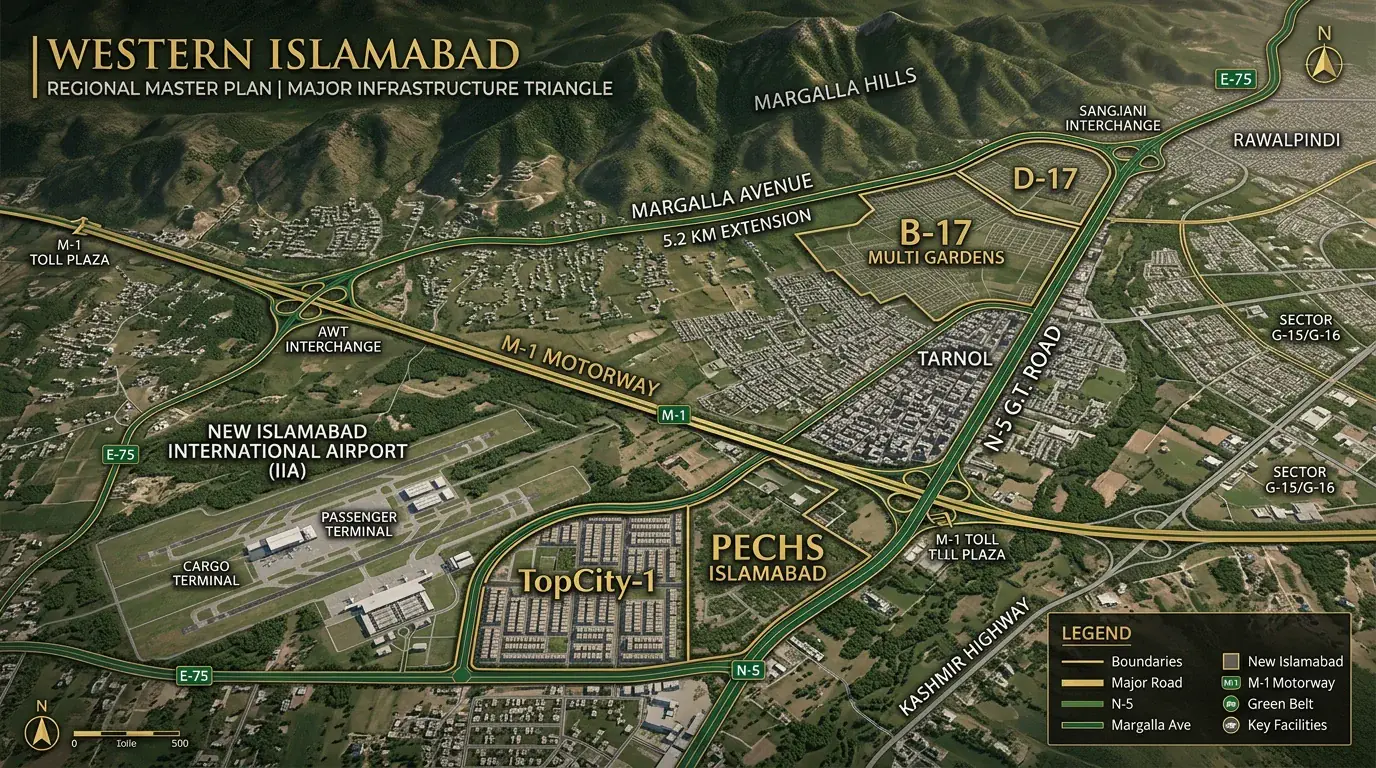
The newly operational Margalla Avenue has materially changed the commercial catchment arithmetic for the G.T. Road strip. Previously, residents of central Islamabad’s F and G sectors faced a 35–45 minute drive to reach the Tarnol/Sangjani belt via congested urban roads. Margalla Avenue now terminates near the N-5 G.T. Road, compressing that travel time to under 15 minutes. The 5.2-kilometre, six-lane Margalla Avenue extension to the M-1 Sangjani Interchange — with earthwork 100% complete and commissioning expected within four to six months — will further connect northern sectors (D-12, E-11, and the C-sectors) directly to the M-1 Motorway and the airport in 15–20 minutes, while unlocking rear access to B-17 Blocks B and C and Faisal Hills.
This connectivity upgrade effectively doubles the commercial catchment population that can reach the G.T. Road strip within a 20-minute drive — a threshold that retail site selection models treat as the primary trade area boundary.
Airport Cargo Terminal Proximity — 12 to 18 Minutes via Srinagar Highway and M-1/M-2 Junction
wp:image {“id”:40816,”sizeSlug”:”full”,”linkDestination”:”none”}
/wp:image
📍 Transit Connectivity Reference: Key Drive Times to the G.T. Road Corridor
The airport proximity figure is commercially significant beyond passenger convenience. The New Islamabad International Airport handles growing air cargo volumes tied to Pakistan’s CPEC-linked export economy. Logistics operators, cold-chain warehousing companies, and freight forwarders require land within a 15–20 minute radius of cargo terminals — and the G.T. Road strip, with its large-format plot sizes (up to 4,000 square yards) and direct N-5 access, is the only sovereign CDA-titled land that meets this specification at a price point below PKR 1.1 lac per square yard.
2. Society-by-Society Impact Analysis: Which Catchments Gain Most?
The corridor’s value uplift does not distribute evenly across western Islamabad. Proximity, access route quality, existing commercial density, and the maturity of residential population all determine how quickly each catchment translates infrastructure proximity into commercial demand. The table below assembles the first verified society-by-society impact matrix for this corridor — a reference that no existing property portal has published in consolidated form.
B-17 Multi Gardens and C-16/C-15 — The Largest Residential Mass Directly Anchored to the Strip
B-17 Multi Gardens commercial property represents the single largest residential catchment directly adjacent to the G.T. Road strip. With an estimated population of 150,000 to 200,000 residents across its developed blocks — and ongoing construction across newer phases — B-17 already sustains active commercial markaz activity. Block C/C1 Markaz commercial plots currently trade at PKR 18 crore to PKR 23 crore for 10-marla units with multi-storey permissions, with per-square-yard rates ranging from PKR 1.4 lac to PKR 6.4 lac depending on block and frontage. The G.T. Road strip’s formal development will create a commercial spine that B-17’s internal markaz plots can only partially serve — particularly for large-format retail (hypermarkets, branded showrooms) and logistics uses that require highway frontage and heavy vehicle access.
C-15 and C-16, the CDA-developed sectors immediately adjacent to B-17, are less populated but benefit from the same direct N-5 frontage. Their value uplift will be more gradual, tied to population infill over a 4–7 year horizon.
D-17 and Mumtaz City — Northern Fringe Beneficiaries with Direct N-5 Access
D-17 sits on the northern fringe of the corridor’s influence zone, with direct N-5 access but lower current residential density than B-17. Mumtaz City, a privately developed society adjacent to D-17, has seen commercial plot prices in the PKR 80 lac to PKR 1.8 crore range for 5-marla to 10-marla units. Both catchments will benefit from the corridor’s logistics and warehousing demand — particularly given their proximity to the Sangjani junction and the M-1 connection — but the residential population base needed to sustain branded retail is still maturing, placing D-17 and Mumtaz City in the medium-term beneficiary category.
TopCity-1 and University Town — Mid-Corridor Catchments Gaining Commercial Frontage Value
TopCity-1 Islamabad property value has already been shaped by its position at the intersection of the Srinagar Highway and the G.T. Road corridor. Block C/D developed markaz plots currently command PKR 4.5 crore to PKR 5.5 crore for 5-marla units, with per-square-yard rates of PKR 1.8 lac to PKR 6.0 lac. The corridor’s development adds a second commercial demand driver to TopCity-1’s existing airport-proximity narrative — corporate and logistics tenants drawn to the strip will generate demand for branded hotel accommodation and serviced apartments within a 10–15 minute radius, directly reinforcing the investment case for Signature Rotana Islamabad.
University Town, adjacent to TopCity-1, is a mixed-use catchment with established educational institutions and mid-density residential development. Its commercial value uplift will be moderate and primarily driven by service retail and F&B rather than large-format or logistics uses.
Faisal Town and PECHS Islamabad — Southern Approach Zones Benefiting from Margalla Avenue Connectivity
Faisal Town Phase 1’s fully inhabited commercial markaz plots trade at PKR 12.5 crore to PKR 14.5 crore for 14–15 marla units on 100% cash, with per-square-yard rates of PKR 2.2 lac to PKR 3.5 lac. Faisal Town Phase 2, still in off-plan booking on 3–4 year installment plans, offers 350-foot boulevard plots with B+G+6 permissions at PKR 1.0 lac to PKR 1.54 lac per square yard. Both phases benefit from Margalla Avenue connectivity to the corridor rather than direct N-5 frontage.
PECHS Islamabad’s proximity to the southern approach of the G.T. Road corridor — combined with its adjacency to the airport belt and CPEC link road — positions it as a corporate residential and serviced apartment demand zone. This is the primary location rationale for Massif Height Islamabad and is examined in detail in Section 6.
Society Impact Matrix: Corridor Proximity, Access, and Demand Uplift
| Society / Catchment | Distance to Corridor | Primary Access Route | Current Commercial Rate (PKR/Sq. Yd.) | Demand Uplift Category | Value Realization Phase |
|---|---|---|---|---|---|
| B-17 Multi Gardens | Direct N-5 frontage (0–2 km) | N-5 G.T. Road direct | PKR 1.4L – PKR 6.4L | High — Retail, F&B, Services | Near-term (0–3 years) |
| C-15 / C-16 CDA Sectors | 1–3 km via N-5 | N-5 G.T. Road direct | PKR 80K – PKR 2.5L | Moderate — Residential services | Near-to-medium (2–5 years) |
| TopCity-1 | 2–4 km via Srinagar Hwy | Srinagar Highway → N-5 | PKR 1.8L – PKR 6.0L | High — Corporate, Hotel, Logistics | Near-term (0–3 years) |
| University Town | 3–5 km via Srinagar Hwy | Srinagar Highway | PKR 1.2L – PKR 3.0L | Moderate — Service retail, F&B | Near-to-medium (2–4 years) |
| D-17 | 3–6 km via N-5 north | N-5 G.T. Road direct | PKR 60K – PKR 1.5L | Moderate — Logistics, Warehousing | Medium-term (3–6 years) |
| Mumtaz City | 4–7 km via N-5 north | N-5 → Sangjani junction | PKR 80K – PKR 1.8L | Moderate — Logistics, Services | Medium-term (3–6 years) |
| Faisal Town Ph. 1 | 5–8 km via Margalla Ave | Margalla Avenue | PKR 2.2L – PKR 3.5L | Moderate — Retail, Corporate | Medium-term (3–5 years) |
| Faisal Town Ph. 2 | 6–9 km via Margalla Ave | Margalla Avenue | PKR 1.0L – PKR 1.54L | Moderate — Mixed-use | Medium-term (4–6 years) |
| PECHS Islamabad | 8–12 km via Airport Rd | Airport Road → CPEC link | PKR 1.5L – PKR 4.0L | High — Corporate, Airport transit | Near-to-medium (1–4 years) |
3. The Tarnol Interchange: Commercial Nucleus or Congestion Bottleneck?
Why Tarnol Phatak Railway Crossing Is the Critical Infrastructure Constraint
The Tarnol Phatak railway crossing — where the N-5 G.T. Road intersects with the Rawalpindi–Kohat railway line — is the single most consequential infrastructure constraint on the entire 16km strip. The crossing handles over 69,000 to 120,000 daily commuters, and frequent railway gate closures during train movements create mile-long gridlocks that can paralyze commercial traffic across the full corridor. For any investor evaluating commercial property for sale in Islamabad along this strip, the resolution of the Tarnol Phatak bottleneck is not a secondary consideration — it is a primary viability determinant.
The Case for a Multi-Level Flyover/Underpass — Without It, Commercial Traffic Gridlocks the Entire Strip
The good news is that this constraint has a funded solution in progress. A PC-I of PKR 2 billion has been tabled for a signal-free flyover, with the Pakistan Environmental Protection Agency (Pak-EPA) granting environmental clearance for an underpass interchange design. A joint anti-encroachment drive by CDA, NHA, and the ICT administration has already cleared over 90% of illegal encroachments along the 15km stretch from 26 Number Chungi to Tarnol Phatak. Critically, the final structural layouts are being synchronized with the Asian Development Bank-backed Main Line-1 (ML-1) railway upgrade to accommodate future high-speed track configurations — meaning the flyover/underpass solution is being engineered for a 30-year horizon, not just the current traffic load.
The CDA’s plan to earmark a portion of the PKR 500 billion+ commercial auction revenue toward structural interchange solutions at Tarnol creates a self-funding infrastructure model: the commercial development generates the capital to resolve the bottleneck that enables the commercial development to reach its full potential.
⚠️ Before vs. After: Tarnol Interchange Scenario Analysis
Without the Flyover/Underpass (Current State):
Commercial traffic accessing the strip from Rawalpindi and southern Islamabad faces unpredictable 20–45 minute delays at the Tarnol Phatak railway gate. Large-format retail and logistics operators — who require reliable supply chain access — will defer investment decisions until the crossing is resolved. Commercial plot values on the Rawalpindi-side approach of the strip remain suppressed relative to the Sangjani/B-17 end.
With the Flyover/Underpass (Post-Completion):
Signal-free movement across the N-5/railway intersection unlocks the full 16km strip as a continuous commercial corridor. Logistics operators gain reliable heavy-vehicle access. Branded retail chains can commit to site selection. The Tarnol end of the strip — currently the most undervalued section — experiences the sharpest price correction upward as the bottleneck premium disappears.
How Tarnol’s Existing Fuel Plazas, Warehouses, and Automotive Clusters Signal Organic Commercial Demand
The informal commercial activity already concentrated around Tarnol is not accidental — it is the market’s organic response to 120,000 daily vehicles and CPEC freight movement. Fuel plazas, tyre and battery shops, truck workshops, cold-storage facilities, and wholesale building material yards have self-organized along the existing roadside because the demand fundamentals are already present. The CDA’s formal development does not need to create commercial demand at Tarnol — it needs to structure, title, and scale the demand that already exists organically.
4. What Business Categories Will Anchor the 16km Strip?
Branded Retail and Hypermarkets — Serving the 500,000+ Residents of B-17, D-17, and TopCity-1
The combined residential population of B-17 Multi Gardens, D-17, TopCity-1, University Town, Mumtaz City, and the C-sector CDA blocks exceeds 500,000 residents — a catchment that currently lacks a single large-format hypermarket or branded retail anchor within convenient driving distance. Chains like Imtiaz Super Market, Carrefour, and Metro Cash & Carry evaluate sites based on a minimum 200,000-person catchment within a 15-minute drive radius. The G.T. Road strip satisfies this threshold comfortably, and the large plot sizes available (up to 4,000 square yards with FAR of 1:8 to 1:10+) can accommodate the ground-floor footprint requirements of hypermarket formats.
Logistics Hubs and Warehousing — CPEC Route Proximity and Airport Cargo Demand
The N-5 G.T. Road is a designated CPEC route segment, carrying freight from Peshawar and the Afghan border toward Islamabad and onward to the Lahore–Karachi motorway network. Combined with the 12–18 minute proximity to the New Islamabad International Airport cargo terminal, the strip is one of the most strategically positioned logistics corridors in northern Pakistan. Large-format warehouse plots (1,000 to 4,000 square yards) with direct highway access and CDA sovereign title will attract third-party logistics (3PL) operators, e-commerce fulfilment centres, and cold-chain facilities serving the twin cities market.
Automotive Showrooms and Fuel Plazas — Highway Frontage Use Cases Already Proven on the Lahore G.T. Road
The Lahore G.T. Road corridor between Shahdara and Gujranwala provides the clearest precedent for what the Islamabad strip will become. Automotive showrooms (passenger vehicles, commercial trucks, motorcycles), fuel plazas with attached convenience retail, tyre and battery outlets, and vehicle service centres are the dominant use cases on every major Pakistani highway commercial corridor. These businesses require highway frontage, heavy vehicle access, and large ground-floor footprints — all of which the G.T. Road strip provides. They are also among the first business categories to commit to new corridors because their site selection criteria are primarily traffic-count driven rather than population-density driven.
Corporate Offices and Mixed-Use Towers — The Long-Horizon Play Once Utility Infrastructure Matures
The highest-value use case — corporate office towers and mixed-use high-rise developments — is a long-horizon play contingent on bulk utility provisioning. Commercial high-rises require dedicated grid station allocations from IESCO and water supply commitments from the Sangjani water treatment complex. CDA’s building control regulations permit FAR of 1:8 to 1:10+ on large avenue commercial plots, with building heights governed dynamically by FAR, plot depth, and adjacent ROW rather than rigid storey caps — enabling 18 to 45+ storey developments where soil and infrastructure permit. However, investors should model a 6–10 year timeline for this use category to become commercially viable at scale.
Business Category Suitability Matrix
| Business Category | Optimal Plot Size | FAR Requirement | Timeline to Viability | Primary Demand Driver |
|---|---|---|---|---|
| Hypermarket / Large Retail | 2,000–4,000 sq. yds. | 1:4 to 1:6 | 2–4 years | 500,000+ residential catchment |
| Fuel Plaza + Convenience | 500–1,000 sq. yds. | 1:2 to 1:3 | Immediate–2 years | 120,000 daily vehicle count |
| Automotive Showroom | 1,000–2,500 sq. yds. | 1:3 to 1:5 | 1–3 years | Highway frontage + CPEC freight |
| Logistics / Warehousing | 1,500–4,000 sq. yds. | 1:3 to 1:4 | 1–3 years | Airport cargo + CPEC route |
| Strip Retail / F&B | 500–1,000 sq. yds. | 1:5 to 1:6 | 2–4 years | Residential catchment density |
| Corporate Office Tower | 1,000–3,000 sq. yds. | 1:8 to 1:10+ | 6–10 years | Utility maturity + corporate demand |
| Mixed-Use High-Rise | 2,000–4,000 sq. yds. | 1:8 to 1:10+ | 7–12 years | Full corridor maturation |
5. Signature Rotana Islamabad: How the G.T. Road Corridor Reinforces the Srinagar Highway Investment Case
TopCity-1’s Position at the Intersection of the G.T. Road Corridor and the Srinagar Highway
TopCity-1 occupies one of the most strategically positioned addresses in western Islamabad: it sits at the functional intersection of the Srinagar Highway — the primary arterial connecting the airport to central Islamabad — and the G.T. Road corridor’s southern approach. This dual-axis positioning means TopCity-1 benefits from two independent demand drivers simultaneously: the airport transit economy that has been building since the New Islamabad International Airport opened, and the emerging commercial corridor economy that the CDA’s 16km strip will generate over the next 3–8 years.
TopCity-1 Islamabad property value has already reflected the airport proximity premium, with developed markaz commercial plots trading at PKR 4.5 crore to PKR 5.5 crore for 5-marla units. The G.T. Road corridor adds a second demand layer — corporate and logistics activity on the strip will generate demand for branded hotel accommodation, serviced apartments, and corporate housing within a 10–15 minute radius.
How Increased Corporate and Logistics Activity on the Corridor Drives Branded Hotel Apartment Demand
The commercial logic is straightforward: as logistics operators, corporate offices, and branded retail chains establish operations along the 16km strip, they generate a sustained demand for business accommodation — visiting executives, project teams, and long-stay corporate tenants who require serviced apartments rather than traditional hotel rooms. This is precisely the demand segment that branded hotel apartment projects are designed to capture. The Lahore DHA Phase 2 and Gulberg commercial corridor precedents both demonstrated that branded hospitality projects within a 15-minute radius of major commercial corridors achieve occupancy rates 15–25 percentage points higher than comparable projects in purely residential locations.
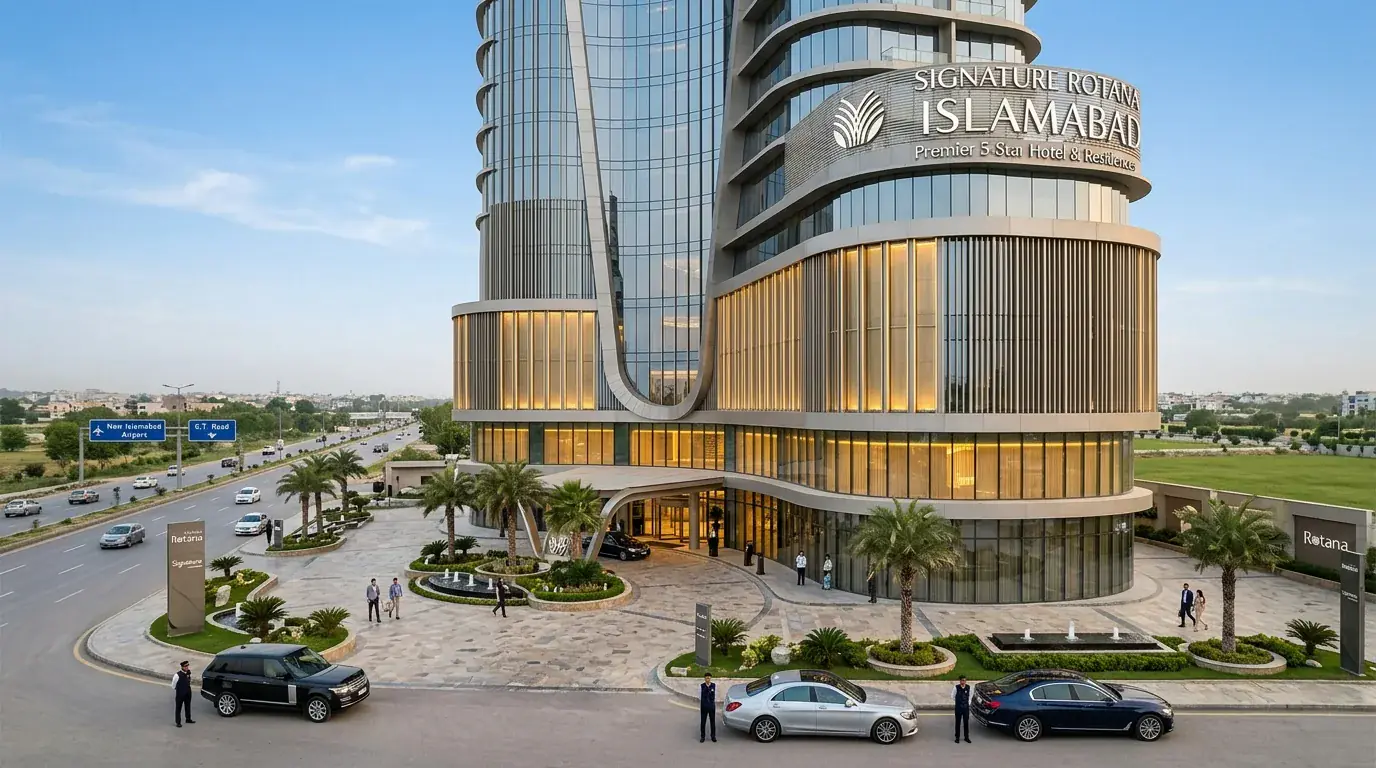
Signature Rotana Islamabad — Configuration, Payment Plan, and Advisory Contact
wp:image {“id”:40817,”sizeSlug”:”full”,”linkDestination”:”none”}
/wp:image
🏢 Project Highlight: Signature Rotana Islamabad
Location: Main Srinagar Highway, TopCity-1, Islamabad
Project Type: 5-Star Branded Hotel Apartments & Residences (Rotana Hotels & Resorts)
Corridor Advantage: 10–14 minutes to G.T. Road corridor; 12–18 minutes to airport cargo terminal; direct Srinagar Highway frontage
Configuration: Studio, 1-bedroom, and 2-bedroom hotel apartments with full Rotana hotel management and rental pooling
Investment Case: Branded hotel management provides professional yield management; corridor-driven corporate demand adds a second occupancy driver beyond airport transit
Advisory Contact: For current payment plan details, floor availability, and yield projections, book a confidential advisory session with MaxX Capitals
6. Massif Height Islamabad: PECHS and the Airport Belt as a Commercial-Residential Convergence Zone
PECHS Islamabad’s Proximity to the Southern Approach of the G.T. Road Corridor
PECHS Islamabad occupies a distinct position in the western Islamabad property map: it is not directly on the G.T. Road strip, but it sits at the convergence of the airport road, the CPEC link corridor, and the southern approach to the commercial strip. This convergence zone dynamic — where airport transit demand, CPEC logistics activity, and the emerging G.T. Road commercial economy all intersect — creates a corporate residential demand profile that is fundamentally different from purely residential societies like B-17 or D-17.
Corporate tenants — logistics managers, airline crew, CPEC project staff, and visiting executives — require furnished apartments within 15–20 minutes of both the airport and the commercial corridor. PECHS Islamabad’s location satisfies both criteria simultaneously, making it a natural corporate housing zone as the corridor matures.
How Airport Transit Demand and Corporate Tenant Growth Underpin Massif Height’s Yield Case
The yield case for residential investment in PECHS rests on two converging demand streams. First, the airport transit economy: the New Islamabad International Airport generates consistent demand for short-stay and long-stay accommodation from airline crew, cargo operators, and business travellers who prefer apartment-style accommodation over hotel rooms for stays exceeding three nights. Second, the emerging corporate demand from G.T. Road corridor businesses: as logistics hubs, automotive showrooms, and eventually corporate offices establish operations along the strip, their staff and visiting executives will seek quality residential accommodation in the PECHS–airport belt rather than commuting from central Islamabad.
For investors evaluating off-plan residential projects in this context, our Off-Plan Properties in Pakistan: Investor’s Guide provides a detailed risk-versus-reward framework applicable to PECHS-area projects.
Massif Height — Apartment Configurations from PKR 72 Lacs, Payment Structure, and Advisory Contact
🏗️ Project Highlight: Massif Height Islamabad
Location: PECHS Islamabad, near Airport Road and CPEC link corridor
Project Type: Modern Residential Apartments
Entry Price: From PKR 72 Lacs
Corridor Advantage: 15–20 minutes to G.T. Road corridor; direct airport road access; CPEC link proximity
Configuration: 1-bedroom, 2-bedroom, and 3-bedroom apartments with contemporary specifications
Investment Case: Corporate tenant demand from airport belt and emerging corridor economy; accessible entry price relative to TopCity-1 branded projects; PECHS location provides established civic infrastructure
Advisory Contact: For current payment plan structure, available configurations, and rental yield projections, connect with MaxX Capitals for a corridor-calibrated advisory session
7. Honest Assessment: Value Maturation Timelines and Risks for Each Catchment Zone
This is the section that most property portals omit — the honest, phased timeline for when each catchment zone will actually see commercial demand translate into measurable price appreciation. For a detailed rate-per-square-yard audit and the PKR 500 billion revenue model underpinning these projections, see our detailed PKR 7.5 lac per sq yd rate audit and PKR 500 billion revenue model for the G.T. Road strip.
Near-Term Beneficiaries (0–3 Years): B-17, Tarnol Frontage, TopCity-1
B-17 Multi Gardens is the most immediately positioned catchment. Its residential population is already large enough to sustain commercial demand, its internal markaz plots are actively traded, and the G.T. Road strip’s development will create a commercial spine that B-17 residents will use daily. Expect commercial plot prices in B-17 Block C/C1 to appreciate 20–35% above current levels within 24–36 months of the first CDA auction announcement, driven by speculative demand ahead of actual strip development.
Tarnol frontage plots — those directly on the N-5 strip — will see the sharpest near-term price movement once the flyover/underpass PC-I is formally approved and funded. The bottleneck premium currently suppressing Tarnol-end values will reverse rapidly once signal-free movement is confirmed.
TopCity-1’s commercial and branded residential values will benefit from the corridor’s corporate demand narrative within the same 0–3 year window, with Signature Rotana Islamabad positioned to capture the first wave of corporate tenant demand.
Medium-Term Beneficiaries (3–6 Years): D-17, PECHS, Mumtaz City
D-17 and Mumtaz City require 3–6 years for their residential populations to reach the density threshold that sustains large-format retail and branded commercial activity. Their logistics and warehousing demand will materialize earlier — within 2–4 years — as CPEC freight operators seek titled land near the Sangjani junction.
PECHS Islamabad’s corporate residential demand will build progressively as the corridor’s commercial activity generates sustained corporate tenant flow. Massif Height investors should model a 3–5 year horizon for rental yield stabilization at target occupancy levels.
Long-Term Plays (6–10 Years): Deeper Sangjani Belt and C-15/C-16 Fringe Sectors
The deeper Sangjani belt and the C-15/C-16 fringe sectors represent the longest-horizon plays on this corridor. Their value realization is contingent on the full maturation of the 16km strip — including utility infrastructure (IESCO grid stations, Sangjani water treatment capacity), the ML-1 railway upgrade, and the complete build-out of the Margalla Avenue extension network. Investors with a 6–10 year horizon and high risk tolerance may find entry prices in these zones attractive, but should not model near-term capital appreciation.
Infrastructure Deficit Risks That Could Delay Value Realization Across All Zones
No honest assessment of this corridor can omit the risks. Four infrastructure deficits could materially delay value realization across all catchment zones:
- Tarnol Phatak Flyover Delay: If the PKR 2 billion PC-I is not approved and funded within 12–18 months, commercial traffic gridlock will deter large-format retail and logistics operators from committing to the strip.
- Utility Provisioning Lag: IESCO grid station allocations and Sangjani water treatment capacity expansion are multi-year processes. High-rise commercial development cannot proceed without confirmed utility commitments.
- Litigation and Stay Orders: Several encroachers and hereditary claimants have approached civil courts for compensation reassessment of the 1967 acquisition. Unresolved stay orders could delay plot demarcation in specific sections of the strip.
- Phased Auction Timing Uncertainty: The CDA’s phased auction model — designed to prevent market flooding — means that direct strip participation may not be available for 18–36 months. Investors expecting immediate auction access should recalibrate their timelines.
Three-Tier Value Maturation Timeline
| Catchment Zone | Value Uplift Phase | Primary Catalyst | Key Risk Factor |
|---|---|---|---|
| B-17 Multi Gardens | Near-term (0–3 years) | Residential density + N-5 frontage | Internal markaz oversupply if strip delayed |
| Tarnol Frontage (N-5 direct) | Near-term (0–3 years) | Flyover approval + 120K daily vehicles | Phatak bottleneck unresolved |
| TopCity-1 / Srinagar Hwy | Near-term (0–3 years) | Airport + corridor corporate demand | Branded project delivery timelines |
| PECHS Islamabad | Near-to-medium (1–4 years) | Airport transit + corporate tenants | Rental yield stabilization lag |
| Faisal Town Ph. 1 & 2 | Medium-term (3–5 years) | Margalla Avenue connectivity | Distance from direct N-5 frontage |
| D-17 / Mumtaz City | Medium-term (3–6 years) | Logistics + Sangjani junction | Low residential density currently |
| C-15 / C-16 CDA Sectors | Medium-term (4–7 years) | Population infill + utility expansion | Slow residential absorption rate |
| Sangjani Belt (deep) | Long-term (6–10 years) | Full corridor maturation + ML-1 | Utility deficit + litigation risk |
8. How to Evaluate Commercial Property in Islamabad Against This Corridor Backdrop
The Three Questions Every Buyer Should Ask Before Committing Capital in Western Islamabad
Before any capital commitment in the western Islamabad commercial property market — whether a direct CDA strip plot, a private society markaz unit, or a branded residential project — every buyer should be able to answer three questions with verified documentation:
✅ Due Diligence Checklist: Three Questions for Western Islamabad Commercial Buyers
Question 1: Is the title sovereign CDA leasehold or private society allotment?
CDA-titled plots carry direct government leasehold with defined building control regulations and no dependency on a private developer’s financial health. Private society commercial plots carry allotment letters from the society, which must be cross-verified against the society’s CDA/RDA NOC status and approved layout plan. These are not equivalent instruments — and the price differential between them should reflect the title quality difference.
Question 2: Is the infrastructure catalyst (flyover, utility connection, road completion) funded and scheduled, or merely announced?
Infrastructure announcements in Pakistan’s property market routinely precede actual execution by 3–7 years. For the G.T. Road corridor, the Tarnol flyover PC-I is tabled but not yet approved. The Margalla Avenue extension earthwork is complete but commissioning is 4–6 months away. Buyers should verify the funding status, executing agency, and contractual completion timeline of any infrastructure catalyst they are pricing into their capital allocation strategy before committing booking money.
Question 3: What is the realistic occupancy or commercial activation timeline, and does your capital structure accommodate it?
Commercial plots on a new corridor typically require 3–5 years from auction to full commercial activation — including construction, fit-out, tenant sourcing, and operational stabilization. Buyers who need capital returns within 18–24 months should not be purchasing raw commercial land on an emerging corridor. Buyers with a 5–8 year horizon and adequate holding capital are the appropriate profile for direct strip participation.
Verified vs. Speculative Inventory — Why CDA Title Plots and Registered Society Plots Are Not Equivalent
🚨 Critical Anti-Fraud Advisory
As of September 2026, no authorized bookings, files, or pre-launch tokens exist for the CDA G.T. Road commercial strip. The project is strictly in its urban spatial planning and anti-encroachment stage. The Capital Development Authority never sells plots through private dealer files, registration forms, or token vouchers. When approved, all inventory will be disposed of exclusively through official public auctions at the Jinnah Convention Centre or designated CDA online auction portals.
Any social media marketing claiming “pre-launch files,” “allotment guarantees,” or “early booking discounts” along the 16km G.T. Road strip is completely unregulated and fraudulent. Verify all CDA auction announcements directly through the Capital Development Authority official portal (cda.gov.pk) before committing any funds.
For investors seeking verified commercial property for sale in Islamabad across all active private society and CDA-titled opportunities — not just the G.T. Road strip — MaxX Capitals maintains a regularly updated inventory of commercial plots for sale in Islamabad across verified, NOC-compliant societies. You can also explore the full range of Islamabad commercial property and off-plan projects on our city landing page.
Consult MaxX Capitals for a Corridor-Calibrated Property Advisory Session
The G.T. Road corridor’s impact on western Islamabad’s commercial property market is real, significant, and already beginning to price into adjacent society values. But the gap between a well-timed, verified investment and a speculative file purchase in this market is enormous — and navigating that gap requires current, on-ground intelligence rather than portal listings.
MaxX Capitals’ advisory team has conducted direct reconnaissance of the Tarnol interchange, Sangjani junction, and Margalla Avenue terminus, and maintains active relationships with developers across B-17, TopCity-1, and the PECHS–airport belt. We can map your capital allocation against verified western Islamabad opportunities — including live inventory at Signature Rotana Islamabad and Massif Height Islamabad — with honest yield context and realistic timelines.
Conclusion: Western Islamabad’s Commercial Transformation Is Real — But Timing and Title Quality Determine Returns
The CDA’s 16km G.T. Road commercial corridor is the most significant sovereign commercial land release in western Islamabad since the capital’s founding master plan. The fundamentals are verified: 2,000 kanals of net developable area, 120,000 daily vehicles on the N-5 axis, 12–18 minute airport proximity, a 500,000+ resident catchment, and a PKR 500 billion to PKR 975 billion revenue potential at starting benchmark rates of PKR 7.5 lac per square yard. The Margalla Avenue connectivity upgrade and the ML-1-synchronized Tarnol flyover solution are both in advanced stages of execution.
For investors evaluating commercial property for sale in Islamabad in 2026, the actionable conclusion is this: the corridor’s downstream impact on adjacent societies — particularly B-17 Multi Gardens, TopCity-1, and the PECHS–airport belt — is already beginning to price into private society commercial rates. The window for below-peak entry into verified private society commercial plots and branded residential projects in these catchments is narrowing. Direct CDA strip participation, when auctions eventually open, will require significant capital (PKR 375 million to PKR 2.5 billion per plot at estimated rates) and a 5–8 year horizon.
The investors who will generate the strongest returns from this corridor are not those who buy speculative files from unauthorized dealers — they are those who enter verified, titled inventory in the right catchment zones at the right phase of the value maturation cycle, with a capital structure that accommodates realistic timelines.
For authoritative guidance on navigating this market, consult the Capital Development Authority (CDA) for official auction announcements, and reference Dawn’s investigative reporting on the G.T. Road corridor for verified news context. For tax implications on commercial property transactions, consult the Federal Board of Revenue (FBR) on applicable CVT, advance tax, and withholding tax obligations before committing capital.
Ready to Navigate Your Next Property Decision?
Before committing booking money or signing builder agreements, ensure your paperwork, approvals, and installment structures are verified against the western Islamabad corridor reality.

Muhammad Ali Dawood
Official AdvisorFrequently Asked Questions
Which housing societies in Islamabad will benefit most from the CDA G.T. Road 16km commercial development?
B-17 Multi Gardens, TopCity-1, and Tarnol-frontage plots are the near-term beneficiaries (0–3 years) due to direct N-5 access and existing residential density. D-17, Mumtaz City, and PECHS Islamabad are medium-term beneficiaries (3–6 years), while the deeper Sangjani belt and C-15/C-16 fringe sectors are long-horizon plays requiring 6–10 years for full value realization.
The key differentiator is whether a society has direct N-5 frontage or relies on secondary road connectivity via Margalla Avenue or the Srinagar Highway. Direct frontage societies capture commercial demand immediately; secondary-access societies benefit from the corridor's broader economic uplift over a longer timeline.
How does the Margalla Avenue connection change the commercial value of the G.T. Road corridor for Islamabad investors?
Margalla Avenue reduces travel time from central Islamabad's F-6/F-7 sectors to the G.T. Road corridor to under 15 minutes, effectively doubling the commercial catchment population that can reach the strip within a 20-minute drive — the standard primary trade area threshold used by retail site selectors.
The 5.2-kilometre Margalla Avenue extension to the M-1 Sangjani Interchange, with earthwork 100% complete and commissioning expected within 4–6 months, will further connect D-12, E-11, and the C-sectors to the corridor. This connectivity upgrade transforms the strip from a western-Islamabad-only commercial asset into a twin-cities commercial corridor accessible from virtually all of ICT.
Is B-17 Multi Gardens a good area to buy commercial property given the CDA G.T. Road announcement?
B-17 Multi Gardens commercial property is among the strongest near-term plays in western Islamabad, with Block C/C1 Markaz plots currently trading at PKR 18 crore to PKR 23 crore for 10-marla units. The society's direct N-5 frontage and 150,000–200,000 resident catchment make it the most immediately positioned beneficiary of the corridor's development.
However, buyers should note that B-17 commercial markaz prices have already partially priced in the corridor announcement. The remaining upside is real but more measured than in less-developed catchments. Verify that any commercial plot you purchase in B-17 carries a clear allotment letter, approved layout plan, and confirmed NOC status — not just a dealer's file.
How far is the CDA G.T. Road commercial corridor from the New Islamabad International Airport?
The G.T. Road corridor sits within 12–18 minutes of the New Islamabad International Airport cargo terminal via the Srinagar Highway and the M-1/M-2 junction, depending on traffic conditions and the specific section of the 16km strip.
This proximity is commercially significant for logistics operators, cold-chain warehousing companies, and freight forwarders who require land within a 15–20 minute radius of cargo terminals. The corridor's large-format plot sizes (up to 4,000 square yards) and direct N-5 access make it one of the few sovereign CDA-titled land parcels that meets logistics site selection criteria at a price point below PKR 1.1 lac per square yard.
What types of businesses are most likely to set up along the CDA G.T. Road commercial strip?
The most likely near-term business anchors are fuel plazas, automotive showrooms, tyre and battery outlets, logistics warehouses, and large-format hypermarkets — all use cases driven by the 120,000 daily vehicle count and the 500,000+ resident catchment. Corporate offices and mixed-use towers are a longer-horizon use case, contingent on utility infrastructure maturation.
The Lahore G.T. Road corridor between Shahdara and Gujranwala provides the clearest precedent: highway frontage commercial strips in Pakistan consistently attract automotive, fuel, logistics, and large-format retail as their primary anchors before transitioning to mixed-use and corporate uses as the corridor matures.
How does the Tarnol interchange affect the commercial viability of the G.T. Road corridor?
The Tarnol Phatak railway crossing is the single most consequential infrastructure constraint on the corridor. Frequent railway gate closures cause mile-long gridlocks that deter large-format retail and logistics operators from committing to the strip. Resolution of this bottleneck — via the PKR 2 billion flyover/underpass PC-I — is a prerequisite for the corridor's full commercial viability.
The positive signal is that 90% of illegal encroachments along the 15km stretch from 26 Number Chungi to Tarnol Phatak have already been cleared, and the flyover design is being synchronized with the ADB-backed ML-1 railway upgrade. Investors should monitor the PC-I approval and funding confirmation as the primary trigger for Tarnol-end commercial plot price appreciation.
Is Signature Rotana Islamabad in TopCity-1 a good option for investors looking to benefit from the G.T. Road corridor?
Signature Rotana Islamabad is well-positioned to benefit from the corridor's corporate and logistics demand, given TopCity-1's location at the intersection of the Srinagar Highway and the G.T. Road corridor's southern approach — placing it 10–14 minutes from the strip and 12–18 minutes from the airport cargo terminal.
The branded hotel management structure provides professional yield management and rental pooling, which is particularly valuable in a market where corporate tenant demand is still building. Investors should model a 3–5 year horizon for rental yield stabilization at target occupancy, with the G.T. Road corridor's corporate activity serving as a second demand driver beyond the existing airport transit economy.
What is the realistic timeline for property values to appreciate in B-17 and D-17 due to the G.T. Road commercial development?
B-17 Multi Gardens is a near-term beneficiary with commercial plot appreciation of 20–35% above current levels projected within 24–36 months of the first CDA auction announcement. D-17 is a medium-term beneficiary with meaningful price appreciation expected in the 3–6 year window, primarily driven by logistics and warehousing demand rather than retail.
The critical caveat for both catchments is that speculative demand ahead of actual strip development may front-load some of this appreciation into the next 12–18 months. Buyers entering at peak speculative prices without a 5+ year holding horizon face the risk of a price correction if CDA auction timelines slip or the Tarnol flyover is delayed.
How does PECHS Islamabad's proximity to the G.T. Road corridor affect the investment case for Massif Height apartments?
PECHS Islamabad's position at the convergence of the airport road, the CPEC link corridor, and the southern approach to the G.T. Road strip creates a corporate residential demand profile that directly supports Massif Height Islamabad's yield case. Corporate tenants from corridor businesses — logistics managers, visiting executives, airline crew — require quality furnished apartments within 15–20 minutes of both the airport and the commercial strip.
With entry prices from PKR 72 lacs and established civic infrastructure in PECHS, Massif Height offers an accessible entry point into this corporate residential demand zone. Investors should model a 3–5 year horizon for rental yield stabilization as the corridor's commercial activity builds to a level that generates sustained corporate tenant flow.


Join The Discussion